

I recently stumbled on a first edition of the classic AdExchanger comic.
I have no idea how I came to possess this artifact of ad tech history, but there it was, blaring at me from a pile of old papers: “Gigantic First Issue!! AdExchanger: An All-Star Collection of the Greatest Advertising Stories Ever Told!” It is dated December 2010.

As I flipped through it, I was worried I’d find that a lot hasn’t changed about our industry in the 13 years since it was published.
Let’s see how far we’ve come.

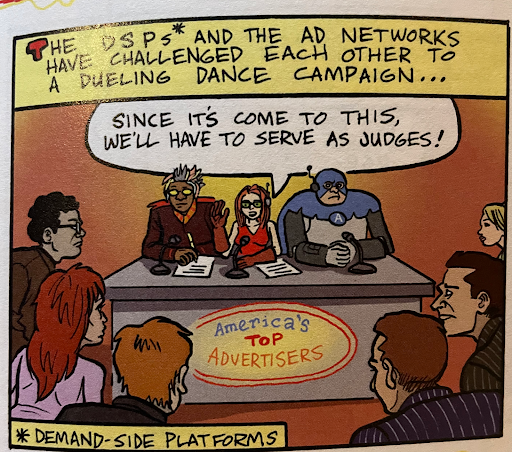
The ad networks vs. the DSPs
The first big section of the story is devoted to the fight between ad networks and DSPs. This was a big deal back then. People forget how effective big ad networks like AOL’s Advertising.com were and how hard it was in the early days to get brands to migrate to a DSP.
Sure, DSPs had the transparency and flexibility the ad networks didn’t, but they also had a fraction of the inventory access they have today.
I’m glad we got over this. The DSPs won. Now, instead of ad networks with limited transparency, we have enormous walled gardens with opaque algorithms that … aww, man.
VERDICT: DSPs won their seat at the table, but, still … everything’s an ad network.
View-throughs are a SHAM!
Our heroes are at the “Church of the Holy View-Through,” which I think is what’s being pilloried here – despite the fact that the cost-per-click (CPC) guy is the one in the stocks. Maybe it’s making fun of both?
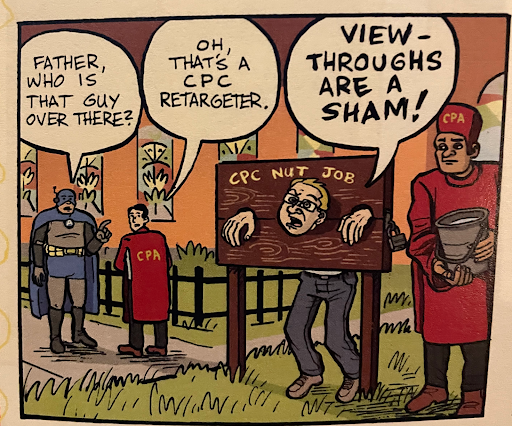
This part of the comic seems to be grappling with attribution being a function of the business model that means more ad spend for the vendor.
The CPC Nut Job presumably represents a famous retargeter that gets paid on CPC. The CPC retargeter is trying to discredit view-throughs because he sells clicks. The idea of using view-throughs as an attribution signal – in which an ad is given credit for a conversion if the end user only saw the ad but didn’t click it – is anathema to an ad network that sells clicks.
Of course, the CPC approach is heresy to the cost-per-acquisition (CPA) ad network that believes it should get paid on view-through conversions.
The view-through vs. click-through debate is still with us. But what’s different now is that we’re talking incessantly about viewability, led by large players on the buy side who get paid on CPM (cost per thousand impressions).
So we got rid of the “through” part (i.e., conversion) and got stuck with the “view.”
VERDICT: The attribution riddle is impossible to truly solve even with deterministic methods still intact (for now). It’s a real threat to the continued growth of the sector that we can’t paper over with “but look how viewable it is!”
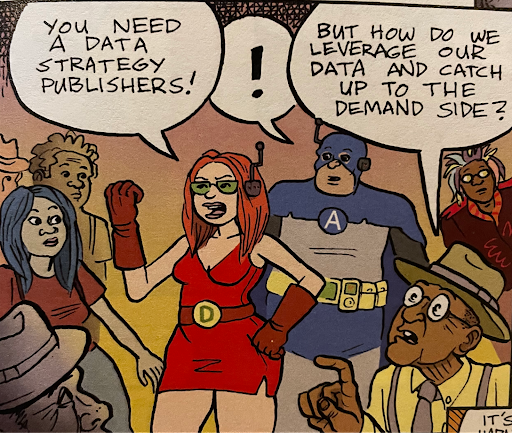
Publishers need a data strategy
Amen to that.
If I can point to one thing that truly hasn’t changed about digital advertising in 13 years, it’s publishers getting screwed. They’re closest to the consumer and the data, but not the money. Maybe the browsers and privacy regulators will finally enable an environment where good publisher data strategy changes this dynamic – and, boy, do publishers need it.
VERDICT: Publishers have a window of opportunity to reclaim ownership of the customer that they didn’t have back then. Will it be enough to reverse the damage done by Facebook et al. and a shrinking open web?

Identifying questionable ad placements before they’re served
Every time the ad industry enters a “contracting budget” period, a growing number of placements become questionable.
Today, it’s made for advertising (MFA) sites. It’s a fair conversation, but if we’re being honest with ourselves, the MFA debate is really just a question of scale. There are only so many ways to reach consumers on the open web anymore. If a brand doesn’t mind running on sites that make my laptop 15º hotter and seize up my web browser, they’re going to reach a lot more consumers.
Then there’s the never-ending brand safety debate. Brand safety and scale are inversely correlated. The more you want scale, the less it’s possible to maintain a brand safety filter that can still deliver at scale.
And as for the constant refrain that advertisers need to be less scared of the news… Declaring news “brand un-safe” limits reach and hurts the ecosystem. When a war is going on, we need to support news sites that actually report the news. And it’s our job to help brands find ways to feel comfortable with that.
VERDICT: Brand safety is in the eye of the beholder. We need to do a better job explaining the tradeoffs between brand safety, scale and supporting news media.
Ad tech in 2023
How much progress have we really made? It’s a mixed bag.
A lot of great things have happened in ad tech that weren’t even in the picture thirteen years ago. We now have several highly successful public ad tech companies. CTV still has tremendous headroom for growth. Third-party cookie deprecation is reshuffling the deck. Google might have to spin off part of its ad tech business. AI something something.
Maybe we have more to be excited about now than we did then. But we’re still struggling with the same fundamental issues we did in early programmatic, in addition to new threats that this comic couldn’t predict. And I worry the industry has gotten worse at explaining the value we bring.
Will we meet the many challenges we face? We’ll have to check back in another 13 years.
“Data-Driven Thinking” is written by members of the media community and contains fresh ideas on the digital revolution in media.
Follow Paul Knegten and AdExchanger on LinkedIn.
For more articles featuring Paul Knegten, click here.









