 “Data Driven Thinking“ is written by members of the media community and contains fresh ideas on the digital revolution in media.
Today’s column is written by Peter Davies, SVP Sales & Marketing at Adconion Direct.
The current definition of an “in-view” ad impression, according to the IAB’s Making Measurement Make Sense (3MS) initiative, is this: “Fifty percent of an ad’s pixels being visible on a web page for more than one second.” Many question whether this goes far enough, but for now it is the standard by which companies such as comScore must build their solutions — and which I am basing this article on.
As the debate over viewability grinds on, some have argued an “in view” impression standard could be a mechanism for portals, publishers and networks to increase yield, adding revenue to their bottom line. They also claim that any planned increases in CPM will be bad for advertisers unless campaign performance increases incrementally as well. (i.e. Not all views result in a click.)
On the surface this stacks up. However let me share two trends with regard to viewability that might surprise agencies and marketers alike.

1. Buying Up Invisible Ads
New tools are being developed to help ad buyers differentiate quality content, as well as “in-view” inventory, with the ultimate goal to protect advertisers from appearing on questionable content or below the fold. Unfortunately, these bidding tools in the wrong hands can lead to unscrupulous behavior.
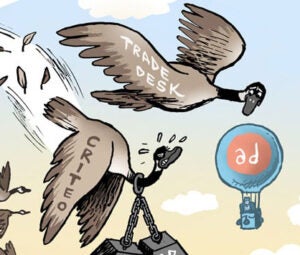
RTB has enabled some people to deploy new tactics that artificially make a campaign look like it is performing, when in fact they are deliberately bidding on impressions that have zero impact. Of course, not all RTB inventory is created equal, and we are currently witnessing and being told of some networks, DSP’s and trading desks that intentionally bid on ads that are out of view. Plus, they bid at the lowest possible CPM in order to gain performance efficiencies — by gaining credit for the last view. These tools, rather than being used for the good of an advertiser to vet content and placement, are instead being used to financially benefit the network, DSP or trading desk.
With bidding tools allowing frequency capping down to the hour, or in most cases within a 24-hour period, the ability to successfully gain credit for the last view conversion is at new levels. Most who bid into exchange inventory know full well that this inventory is ‘crummy’ and not ideal for brand building.
To address these tactics, technologies do need to evolve. Specifically, they need to predict which ad is in-view and which are not, before the ad call – not after. The tech will then in turn block that ad call so that no out of view ads will be served. Unfortunately this doesn’t exist today, so advertisers need to take the lead and work with partners who are mapping their site, network, buying tactics and placements to ads that are only in-view, and who are developing methodologies into their algorithms to better predict viewability.
2. Facebook Exchange
Advertisers can now use their network, DSP or trading desk partners to leverage their audience data to target users within Facebook. Currently the ads are cost effective. Why? Crudely, because there are a ton of them available, therefore supply outstrips demand. (Over 1bn users, five to eight ads per page anyone?) This makes Facebook Exchange the ultimate cookie bomb opportunity.
While more demand is a great thing for Facebook (and their stock holders) and increased supply is good for advertisers (incremental reach), it does beg the question: Can an in-view text and image ad have the same impact as an in-view display ad, and is this incremental reach truly incremental to my existing display? These native ad units consist of a small image, 90 characters, and are stacked on top of each other away from the prime real estate on Facebook – the newsfeed. You be the judge.
There is no doubt that these ads can have a positive impact on performance. However advertisers should be developing attribution models that ensure the performance is in fact incremental, instead of stealing away last view from another display placement that might be of more value.
One of our advertising partners recently said accepting view-based conversions in Facebook Exchange was the same as accepting view-based conversions from their search activity. In other words, they don’t allow it. Conversely, we have other partners who do accept view-based conversions, but within a tighter time frame and at times with less value than views on display advertising.
While we wait for tech solutions to catch up with our thinking, advertisers should work with accredited viewability tracking companies, as well as media partners who have invested in integrating with these technology solutions, in order to provide transparent, verified and validated impressions. If your partner does anything less, what are they hiding?
Follow Adconion Direct (@Adconion_Direct) and AdExchanger (@adexchanger) on Twitter.