Faded Glossies
The past decade has been rough for legacy media.
Many iconic magazines, including Sports Illustrated, Newsweek and Time, have been taken over by private equity firms or absorbed into various digital monetization ventures.

Condé Nast stands as one of the final holdouts among traditional magazine publishers still vying for relevance in the digital era.
Unfortunately, Condé’s efforts to reinvent itself with new revenue streams are having mixed results, The Wall Street Journal reports. The sturdiest revenue pillar is live events, at least for one of its titles, Vogue, which hosts a show called Vogue World in Los Angeles, plus the Met Gala in NYC.
Ads, though? Not so much.
“We don’t expect advertising to be a growth engine for the business,” Condé CEO Roger Lynch tells the Journal.
Which raises a pressing question: Can online magazines survive when ads have plateaued and digital subscriptions still don’t cover the cost of producing quality journalism?
Maybe the answer is … AI. Condé has content and data licensing deals with OpenAI, Perplexity and Amazon. But those deals could have steep half-lives, especially when a publisher’s value is primarily tied to its library of content.
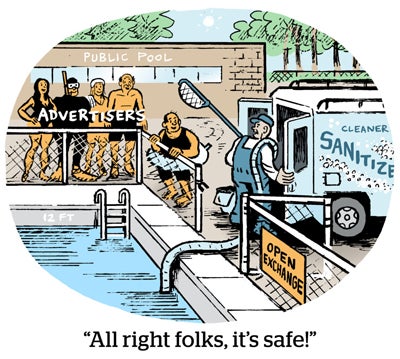
Checkmate, Google
Last week, Amazon Web Services (AWS) announced the launch of RTB Fabric, a cloud infrastructure service built specifically to support programmatic and ad tech companies.
Ad tech firms are a large client base for AWS, so it makes sense for Amazon’s cloud division to develop a product like this. But as Digiday reports, the launch is also a shot across the bow at a major competitor: Google Cloud Platform (GCP).
AWS is the top dog in cloud computing, with a 30% global market share compared to GCP’s 13%. But over the past three years, Google has aggressively courted ad tech firms to migrate from AWS by using incentives, such as computing credits.
Now, AWS is matching Google’s playbook by rolling out similar credits and bundled deals for its data-processing tools to entice companies to adopt RTB Fabric.
More importantly, however, the product could attract net-new customers to the cloud market, one of Digiday’s sources suggests. A disproportionate number of ad tech companies own their own cloud servers rather than default to a public cloud (i.e., AWS, GCP or Microsoft Azure).
In other words, even if RTB Fabric only sways a few customers from GCP or Azure, there’s still significant growth potential.
Oh No You Sheri-don’t
Despite a purported valuation of $28 billion, Paramount Skydance has been hemorrhaging value lately.
First, the merged company made headlines for having three different takeover offers rejected by Warner Bros. Discovery. Then, last week, Variety reported that Paramount is expected to eliminate another 2,000 or so jobs in the US starting this week.
On top of that, Paramount will also be losing its golden boy, producer and showrunner Taylor Sheridan, to a new film and TV deal at NBCUniversal, Deadline reports.
Sheridan, whose current series include “Landman,” “Mayor of Kingstown,” “Tulsa King,” “Lioness,” and at least three upcoming “Yellowstone” spinoffs, will spend the next three years finishing out his current contract with Paramount before moving on to NBCU.
Which is good, because it gives Paramount+ some time to pivot from its almost exclusively Sheridan-based advertising strategy.
Seriously, just look at how much the streaming platform has leaned into endemic brand collaborations and show-specific streaming ad spots over the past year. Once the shows that inspired those offerings are over, what does Paramount+ do next?
But Wait! There’s More!
The Guardian is soliciting responses to a consumer survey about unwanted marketing emails. [The Guardian]
Have Big Tech platforms and dashboards infected our ability to market creatively? [The Drum]
AI chatbots like OpenAI and Gemini parrot back Russian state-sponsored propaganda when asked about the war against Ukraine. [404 Media]
Roughly 500,000 ChatGPT users a week may be experiencing mania or psychosis, OpenAI estimates. [Wired]
Here’s what ads on your $2,000 smart fridge will look like. [The Verge]
Microsoft confirms earlier reporting that it’s testing a standalone cloud gaming service that will be free and carry ads. [NYT]
Canada’s anti-tarriff ad – which aired in the US – led to Trump imposing, you guessed it, higher tariffs on Canada. [WSJ]