
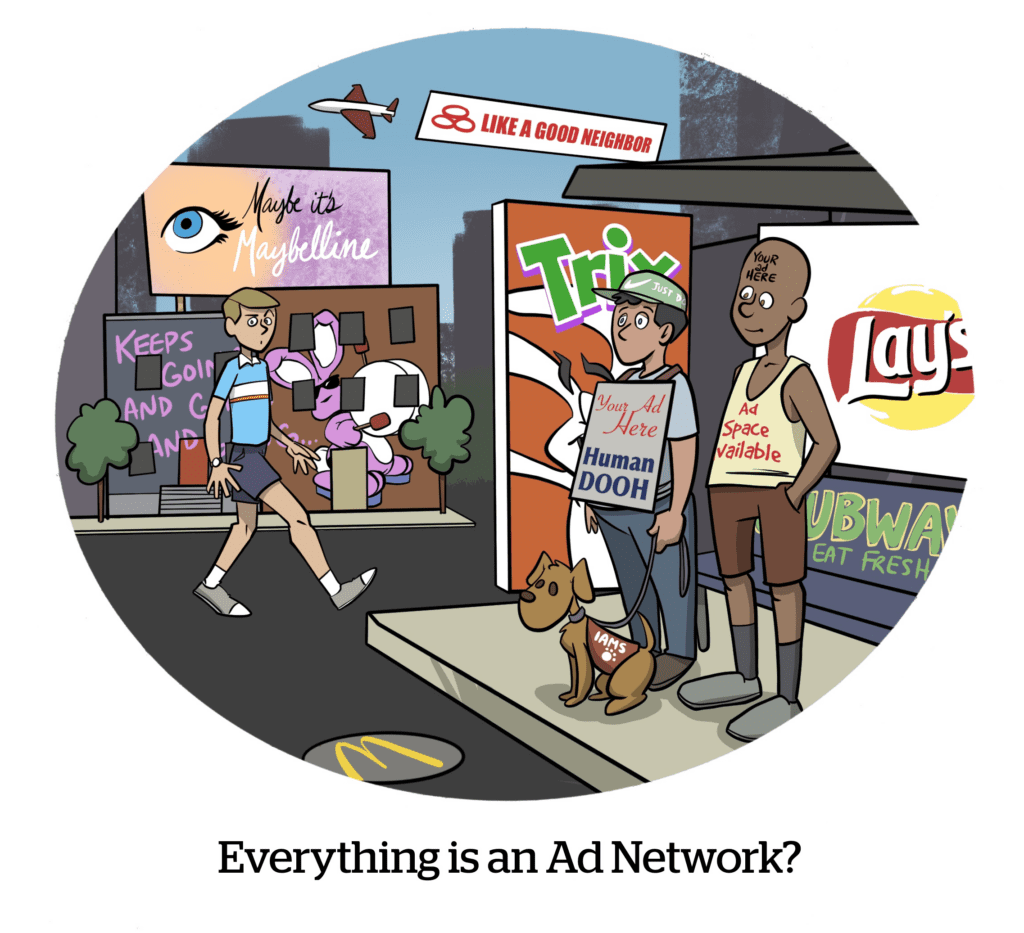
Need A Lift?
Lyft is expanding its retail media business by decoupling its first-party data from its media. Through a partnership with StackAdapt, advertisers will be able to use Lyft’s data for audience segmentation or attribution, rather than just advertising on Lyft’s network.
“It’s like building a corner store,” Lyft Media VP and head of sales Shane Dwyer tells Adweek. “I want this store to be open to anyone who wants to come in and shop – or whoever wants to come in and run ads with us.”

It’s a big decision for a retailer entering the ad biz. Will data be tied strictly to their own ad media, or can the data be sold separately to help create location-based or interest group segments or attribute campaigns? An open approach to data sales can mean exposing the possibility of outside advertisers or companies running your data to conquest new customers, for example.
Is The Trade Desk or Criteo worth it for Macy’s, for example, to permit them to target Macy’s customers elsewhere around the web? Macy’s could forbid the practice, as Walmart does with TTD, but they’d earn less.
Lyft’s new partnership also shows the patchwork of integrations in retail media when they go the “partner” vs. “build” approach. Lyft is working with Kevel, which integrates with StackAdapt, which brings the advertisers.
Lean Times, Lean On Ads
If there is an economic downturn, how does that play out for social media influencers?
Social media advertising is well insulated, since YouTube and Facebook are often not the first channels cut compared to, say, the open web or mobile network video.
But the general consensus is that performance media fares better than upper-funnel branding during lean times, since those ads have clearer connections to driving a sale.
Which explains why, according to Digiday, many creators are changing tactics right now. In recent years, there were efforts to sell directly to fans, either through tips, tip-like features, affiliate sales or subscriptions.
But now the focus is returning to earning money from advertising revenue shares – with platforms like good ol’ YouTube – instead of asking subscribers to pony up money. Or they want long-term deals with brands.
“I think there is a bit more willingness to do a long-term deal that is just a solid deal – not insane money, but good, consistent money with a brand,” says Gaylen Malone, SVP of talent at the creator management firm Loaded.
Paramount, Para Bellum
President Trump has publicly called on Federal Communications Commission Chairman Brendan Carr to “impose the maximum fines and punishment” on Paramount and possibly even revoke CBS’s broadcasting license, Fortune reports.
Trump posted to Truth Social on Sunday taking issue with two segments from that night’s “60 Minutes,” one about the war in Ukraine and the other about Trump’s threats to annex Greenland.
In 2017, this would have been the sort of complaint that everyone made fun of on Twitter, and then moved on. But in February, Trump signed an executive order that claims to grant him full authority over independent agencies like the FCC, including the power to replace agency leaders at will.
(Never mind that Carr, who was recently spotted wearing a gold lapel pin of Trump’s head, seems eager to follow the president’s commands even without threats.)
Add to that the fact that Trump is already suing Paramount for $20 billion over a 2024 “60 Minutes” interview with Vice President Kamala Harris, which the company is trying to settle (despite its ostensible protections as a journalistic outlet), and things are not looking good for the company right now.
Maybe if the Paramount-Skydance merger still goes through, incoming CEO David Ellison can get his Trump-friendly father Larry to intervene.
But Wait! There’s More
Google is using its cloud business to pitch generative AI creative tools. [Digiday]
Current confusion aside, Nintendo’s Switch 2 is categorized as a “toy” and wouldn’t qualify for any tech exemptions in the first place. Sorry, gamers. [Polygon]
Blockgraph and the 4A’s co-publish a report detailing the advantages of household-level identity for streaming and linear ads. [release]
Meta will start training its AI models on public content in the EU. [TechCrunch]
New York City mayoral candidate (and ousted former state governor) Andrew Cuomo reportedly used ChatGPT for parts of his campaign’s proposed housing plan. [Hell Gate]
The Dalí Museum in Florida worked with ad agency Goodby Silverstein & Partners to release an AI-generated trailer for the unmade film Salvador Dalí wrote for the Marx Brothers – and it’s getting panned online. [Artnet]







