
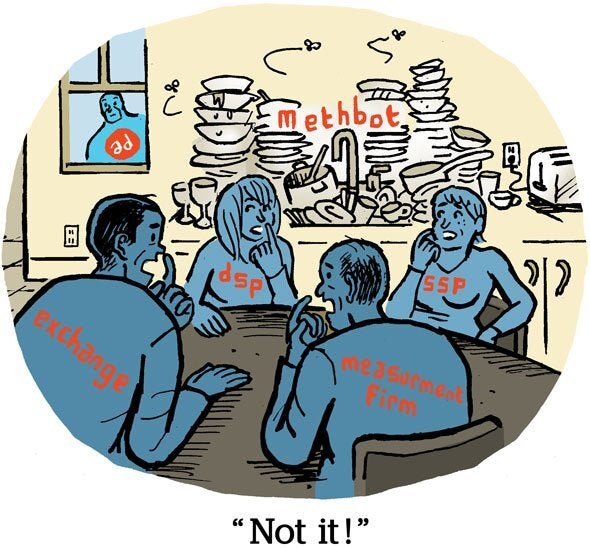
Whose Mess Is This?
One unwritten rule for advertising and analytics platforms is to never make dramatic overnight changes that impact a customer’s day-to-day life.
Quiet overhauls can wreak havoc in the background on identity graphs, targeting capabilities, software plugins, server setups, etcetera. But the customer UI usually exists at a safe remove, like the chaos of a three-star restaurant’s kitchen compared to its stately dining room.
Most Google advertisers know nothing of “PMax” or “Privacy Sandbox” (RIP) throwing wrenches in the gears. Nor do Meta advertisers generally understand that the platform’s vaunted flywheel is more like a cartoon clock with an impossibly large number of gears and springs popping out while the whole thing bounces down the road.
Sometimes, though, these rules are broken – and when that happens, it always gets ugly.
Consider how Google Analytics customers were shifted (or more so frog marched) from the canonical Universal Analytics to the new GA4. Just mentioning the new product can still elicit small tics and sounds of frustration from its unwilling users.
More recently, Meta advertisers have had to wrestle with bug-ridden, skewed analytics due, at least in part, to an overhaul last month that affects how the platform attributes clicks and searches.
Gmail, too, recently changed its pixel tracking, causing creators on Substack to see seemingly poor results.
Guess the mess in the kitchen is spilling out into the dining room.
How Would You Like To PayPal?
Ahead of POSSIBLE in Miami next week, PayPal has unveiled a new platform called Curated Ads that aims to bring more attribution to connected TV, Adweek reports. This is an ambition that PayPal shares with just about every other CTV vendor and streaming publisher out there.
Attribution will always be trickier in TV environments compared to other digital ad channels because people still don’t generally buy things straight from their TV. If they do make a purchase, it’s typically through a second screen. More often, people will just keep a brand or product in mind to buy later when they’re not in the middle of a show.
But marketers are demanding more proof of performance, hence the recent rise of conversion APIs in CTV Ad Land.
Back to Curated Ads, the platform lets buyers use PayPal’s transaction data to create audience segments to target across Warner Bros. Discovery, Tubi and Spectrum Reach. Buyers can then link those streaming ad exposures to sales.
Looks like Amazon won’t be the only sales data behemoth battling it out for a bigger slice of the CTV ad pie this upfront season.
Betting+?
But, hey, forget buying something from your TV – what about betting on it?
Polymarket and Kalshi (which characterize themselves as prediction markets, not gambling sites, thank you very much) are building a bigger TV presence. Beyond spending more money on TV ads, they’re partnering with news networks like CNBC, CBS and CNN to encourage viewers to bet on events like news and awards shows.
Gamifying the TV experience can increase viewership and engagement for networks while also helping prediction markets gain legitimacy and brand recognition. But this trend also has ethical implications for the advertisers and networks that collab with prediction platforms for attention.
“The prediction becomes the leading carrier of truth, and then these markets, instead of just creating events, they actually influence events,” Olivier Toubia, a professor at Columbia Business School, tells Marketing Brew. It’s clear how easily this can become problematic when applied to the news.
Betting on events like elections or war can introduce undue influence over significant occurrences, while presenting speculative possibilities as realistic outcomes.
Are short-term engagement spikes worth the potential long-term ramifications for society? This wouldn’t be the first time the advertising industry has had to grapple with that question.
But Wait! There’s More!
Tim Cook built Apple Ads, but his successor will have more difficult tasks at hand. [Adweek]
SiriusXM is now the exclusive advertising partner for YouTube’s audio inventory in the US. [Variety]
The NFL is making its case to the FCC that most of its games still reach fans for free on broadcast TV. The Commission, meanwhile, is pushing back against the migration of sports to streaming and scrutinizing the NFL’s special antitrust exemption. [WSJ]
AI’s ability to approximate human social skills is making it into an effective tool for hyper‑personalized phishing scams. [Wired]
Threads is launching a live chat function, which is apparently different from Meta’s Facebook Messenger and WhatsApp. [TechCrunch]
Inside Paramount’s vertical video app plans. [Business Insider]
You’re Hired!
Seattle-based indie media agency Copacino Fujikado names Ellie Caldwell as its first head of strategy. [release]









