
Here’s today’s AdExchanger.com news round-up… Want it by email? Sign up here.
Bluesky Thinking
The sky is blue, but money is green.
Put another way, despite Bluesky’s growing popularity, brands aren’t quite ready to jump on the bandwagon, Adweek reports.
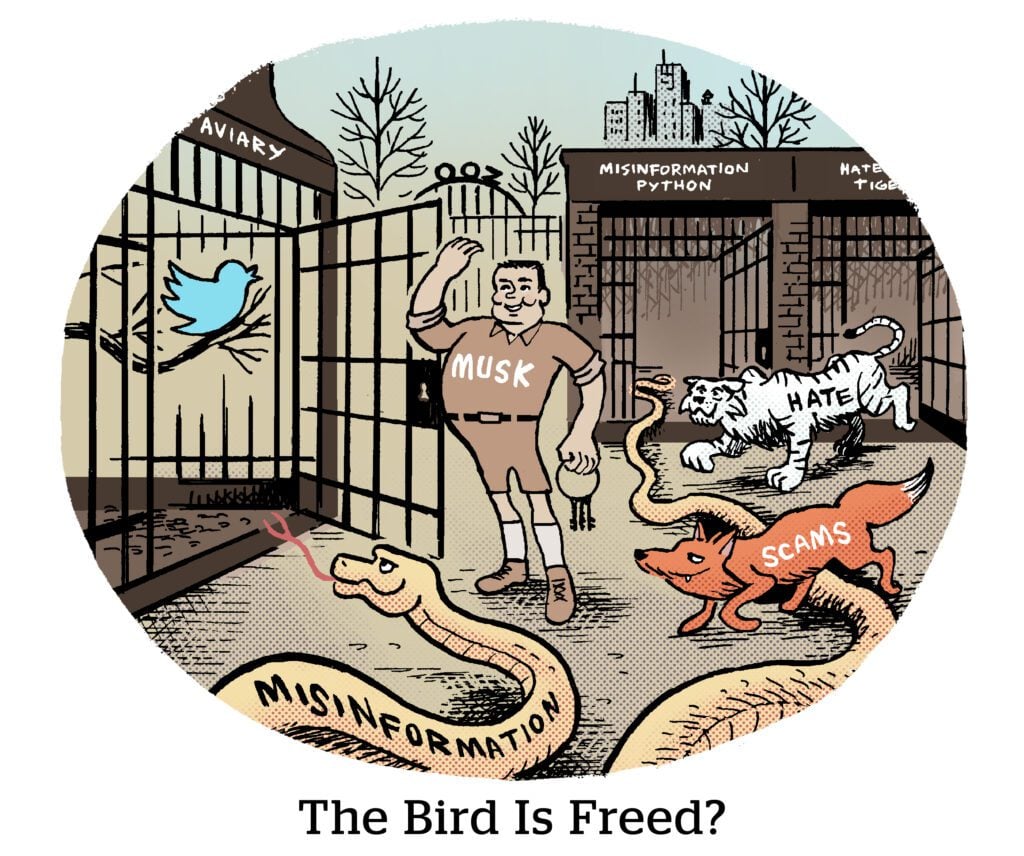
Despite serving as a respite for waves of X-weary users after Elon Musk’s acquisition of Twitter and, more recently, following the US presidential election, it’s not big enough to be on the radar for marketers.

Advertisers need to decide whether “the juice is worth the squeeze when the scale just isn’t quite there yet,” says Dana Neujahr, managing director of creative agency We Are Social.
Still, Bluesky’s user base has more than doubled since October, according to data from Similarweb, with over 21 million users as of Nov. 21. Yet it’s only got a fraction of the users that Threads does at 275 million, and same for X. (Musk claims 600 million monthly actives; recent Sensor Tower data set X’s monthly actives at about half that.).
But wait. Isn’t this whole debate kinda moot?
Bluesky doesn’t even have an ad offering yet. And earlier this year its CEO, Jay Graber, told Wired that “we can’t enshittify the network with ads.”
Cabin Pressure
Speaking of enshittification, it’s ruined American airlines – not that one company, mind, but rather the whole lot.
A Bloomberg report by Amanda Mull breaks down why airline ticket prices and quality have sharply diverged, so people in coach (or basic economy, god forbid) have far worse experiences compared to those who purchase upgrades or join loyalty programs.
The old standard was that business travelers would upgrade and accrue miles, while general travelers lumped it in coach. The airlines competed on the quality of the general cabin.
During post-quarantine marketing pushes, airlines doled out cheaper upgrades. But as prices rose, airlines also began data-driven programs to carefully target people based on how much extra they’d be willing to pay for certain upgrades and offers.
Other industries have a tendency to copy airlines, which have been a bellwether for how many companies now approach their own loyalty and reward programs and credit card partnerships.
But hopefully airlines aren’t a bellwether for “individual-level prices,” which is the MBA term for the practice.
“The tiering of prices makes winners and losers,” says Joseph Nunes, a marketing professor at the University of Southern California’s Marshall School of Business. “Lots of people who used to not have it so bad are gonna wind up being losers.”
Some Pig
If you’ve ever gotten a random “hello” from an unknown number, then you’re familiar with how the typical “pig butchering” scam starts. From that innocuous greeting, scammers begin a rapport that eventually leads to setting their new friend up with a cryptocurrency account (which is, of course, fraudulent).
It’s become a big problem for most messaging services since 2020, and Facebook is no exception to that. However, Meta’s been pretty tight-lipped about the subject – until now, Wired reports.
In a new blog post, Meta claims it’s taken down more than two million accounts linked to scam centers in the Middle East and Southeast Asia. (In addition to pig butchering cons, the same groups are often seen serving ads that lure job seekers and force them to serve as scam operators in the ring.)
It’s better late than never, but probably won’t be enough to stop the pig butchering trend.
But (and this is a big but!) if Meta were to crack down on AI-generated content – which pig butchers have already started using, of course – then that might have the added benefit of weeding out more scammers.
But Wait, There’s More!
The Hawaiian newspaper that unveiled two new AI reporters two months ago has already “fired” them. [Wired]
Warner Bros. Discovery is launching its own shoppable ads on Max. [Ad Age]
FCC Chair Jessica Rosenworcel agrees to step down when Donald Trump assumes the presidency. [TechCrunch]
Tubi’s getting into the short-form video content game with “scenes.” [CNET]
As a proposed fix to Google’s search monopoly, the DOJ seeks to unwind Google’s partnership with generative AI startup Anthropic and block any other potential search partnerships. [Bloomberg]
A Google employee union is petitioning the US government to consider worker impact in its antitrust remedies. [The Verge]
Cape, a mobile network that provides hard-to-track cellphone service for US government employees, is now selling devices to high-risk members of the general public. [404 Media]








