

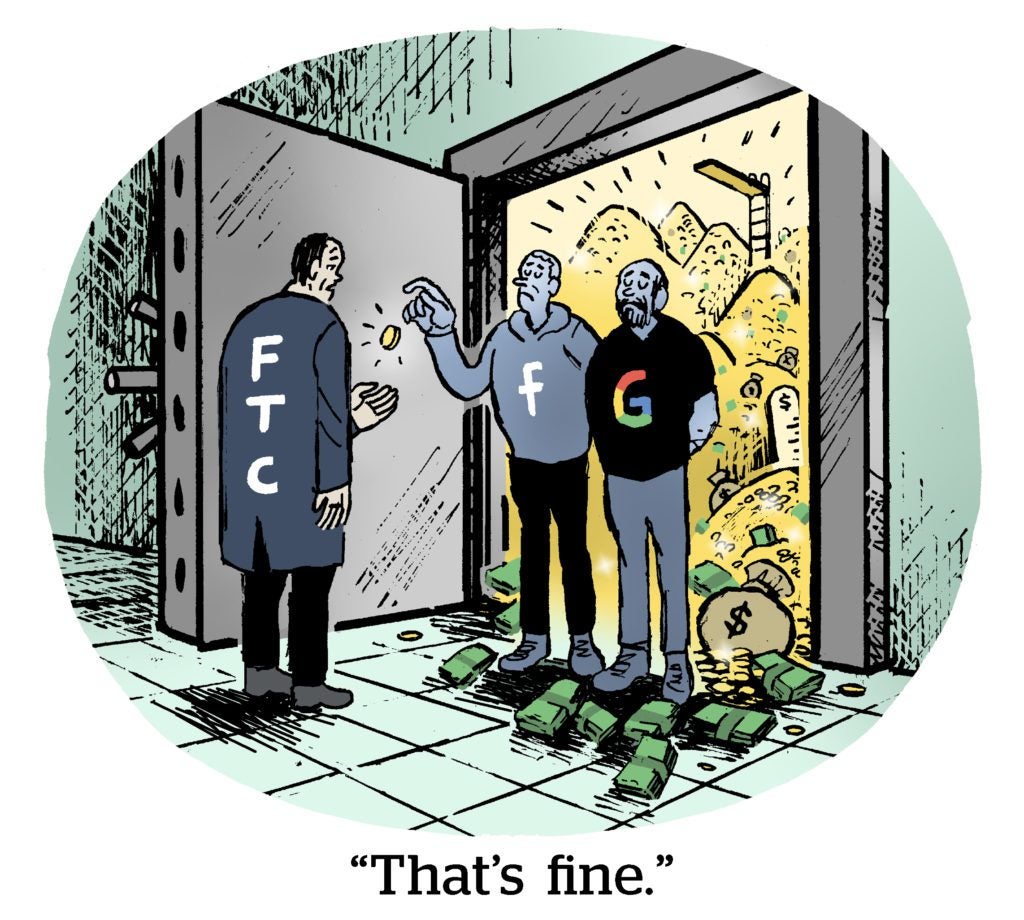
Last week, the FTC launched an inquiry into Big Tech’s relationship with generative AI companies. The inquiry is the latest sign that the agency has its watchful eye on the AI sector.
Chair Lina Khan announced the probe during an FTC forum to address competition concerns related to AI technology, its first-ever tech summit focused on artificial intelligence. Speakers included journalists, academics, researchers, technologists and experts from the government and civil institutions.
Specifically, the FTC is investigating the investments and partnerships between generative AI developers and cloud service providers. It’s gathering information from Alphabet, Amazon, Anthropic, Microsoft and OpenAI to see if the relationships these companies have forged are stifling competition in the AI space.

“There’s no AI exemption from the laws on the books,” Khan said at the summit, “and we’re looking closely at the ways that companies may be using their power to thwart their competition and trick the public.”
But nested within that statement is a thorny challenge: The FTC must protect competition without thwarting innovation.
To the rich go the spoils
The FTC may need to step in to protect competition because the unequal playing field of the generative AI industry verges on a rigged game. Startups need access to computer processing power, chips and training data to compete with the dominant players. They also need venture capital, and there’s a growing divide between haves and have-nots.
Although many companies are getting “tons of venture capital at insane prices,” said Stephanie Palazzolo, an AI reporter at The Information who spoke at the summit, “on the other hand, you have a number of startups that are struggling to find any funding at all.”
Meanwhile, large corporations already have a leg up on up-and-comers, particularly when it comes to their vast troves of consumer data.
Access to high-quality data sets, particularly niche ones in health care and finance that demand accuracy and diversity, are a “key source of competitive advantage,” said Amba Kak, executive director of the AI Now Institute, an AI research and policy organization.
And Big Tech firms have “near unlimited capital to invest in labor” to curate and refine these data sets, Kak said, as well as to train generative AI models to ensure they excel at specific tasks.
For instance, Meta did 14 rounds of training for its Llama 2 model to collect feedback about the outputs, then upgraded the models accordingly.
It only stands to reason that if massive companies team up and combine their hefty financial and technological resources, then startups are toast.
Old errors, new eras
When too much power accrues to a select few, history proves that no one wins in the long run – and the greatest harms are to the US public.
In 1997, Boeing merged with civil aircraft company McDonnell Douglas, knocking out competition and consolidating most aerospace production into a swollen mega entity. The merger eventually turned Boeing into “an ossified, money-losing corporation with dangerous quality issues,” Khan said, as seen in recent headlines.
Without protections against too much consolidation, innovation could suffer and Big Tech platforms run the risk of following the same path as Boeing – except their missteps won’t be as immediately obvious as a plane falling apart midair, Khan added.
For decades, the FTC opted to allow the online advertising industry to self-regulate – a hands-off approach the current commission clearly regrets. Now, the government is playing catch-up to regulate what it believes to be rampant “commercial surveillance.”
“Nothing about pervasive data collection, ad tracking, the shape of social media or the dominance of a few tech firms was inevitable,” said FTC Commissioner Rebecca Kelly Slaughter. “Inaction in the face of those developments was a policy choice.”
Open up
One way the FTC can avoid repeating the mistakes of the past and take action now is to push for open-source generative models.
None of today’s generative AI models is truly open source. To be open source requires access and transparency, according to Jonathan Frankle, chief scientist focused on neural networks at enterprise software company Databricks.
Access means the ability to manipulate and work with a model, like in the case of Llama 2, rather than just talk to it (think ChatGPT). Transparency means knowing how the model is built, such as what data is used to train it.
If people understand how AI models work and are able to customize them, they aren’t dependent on the AI model makers to guide them through every change. They have better control over the models and the business use cases they choose to pursue. They’re on more solid ground.
Which is why “centralized, shared resources for improving the safety and quality of AI models” is on Frankle’s wish list. Anyone could pull a data set off the shelf, whether they’re a fledgling startup’s founder looking to fine-tune a model, a Fortune 500 company or an academic doing research and asking the hard questions.
One of those questions is what counts as innovation for the public good, Kak said. AI contenders measure progress by “narrow benchmarks,” such as scale and speed, she said. They aren’t reckoning with the longer-term impact on the environment, labor conditions and consumer privacy.
But it’s imperative that we grapple with these fundamental yet difficult-to-answer questions about power and governance before it’s too late, Khan said.
“Will this be a moment of opening up markets to fair and free competition, unleashing the full potential of emerging technologies,” she said, “or will a handful of dominant firms concentrate control over these key tools, locking us into a future of their choosing?”








