

 The line between enterprise software and digital agencies is blurring.
As the merger between Publicis and Omnicom came to a screeching halt last week, the growing demand for data and tech prowess within the agency environment was all too apparent.
In the case of computing giant IBM, developing an in-house agency has been a (lesser-known) focal point for the past 17 years. Recently the company shared plans to invest $100 million in global agency services including 10 new client experience labs and 1,000 new employees.
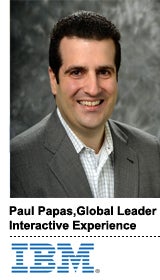
Is the agency model of tomorrow a mix of a systems integrator, tech lab and creative consulting service? Paul Papas, global leader for IBM Interactive Experience, shared his thoughts.
AdExchanger: How long has IBM had a digital agency?
PAUL PAPAS: We have had a digital agency inside of IBM, IBM Interactive, for 17 years. When you go back to the 1996 Atlanta Olympics, it was the genesis of that digital agency capability for us. We lived through the dot-com boom and bust and we operate as a separate group within our overall global business services group or consulting organization. Obviously we’re able to integrate into other work we do, but largely we are an independent group.
Why the pivot into “Interactive Experience?”

It probably goes back seven years, when the iPhone was launched. In the last three years, the whole world flipping on mobile and everyone being connected and having access to high-bandwidth, low-cost Internet access has been fundamentally transformative to the way our clients were doing business.
We were being brought into strategy work we would normally do, but we (were doing more of) this creative and design work, and we couldn’t do that without bringing in the analytics team that we have. And we can’t do any of this work if it’s not grounded in “How do you make it real?” and have the technology wherewithal to do design that is implementable. More and more of our work over the last 12-18 months has become multidisciplinary, where you can’t do strategy without design, analytics and technology.
With the Publicis Omnicom merger nixed, what does this say to you about the competitive landscape?
When we considered what to name this new organization, we saw a unique opportunity for us in that we’re not just a digital agency, a management consultancy or a systems integrator. Some of our competitors among consultancies, they’ve focused on digital. It would have been a huge mistake if we said, “We’re the IBM Digital Group.” When you say digital-only, it implies you’re excluding physical and live experiences and for us it’s all about digital and physical convergence. That was a big decision factor for us to not focus on digital as a term because it’s distracting and limiting.
Do you face equal competition from brick and mortars themselves, such as WalmartLabs, which is acquiring tech quickly?
We’re opening up 10 new labs of our own around the world and these are spaces where we’re going to co-create experiences with our clients where you can talk to data analysts, tech people, designers and strategists, all collaborating and doing projects together. The company spends over $6 billion a year on research. What we announced as part of the Interactive Experience team is we created this initiative with research development that began as the Customer Experience Lab team, and we take 100 researchers and put them into our Interactive Experience team.
Can you give a client use case for the labs?
We work with a very large and prestigious airline, which was looking at in flight passenger experience, so they came for an exploration workshop. We hooked up a business-class seat with all these biometric sensors so you can measure heat, eye strain, weight, and they tied that into one cabin seat design, and are also turning that into creating these flight experience journeys. For instance, if you’re flying to Hong Kong and when you land you know you’re heading straight to the office, your sleep regimen may (differ). They can work that into planning your interaction with them, and implement sensors to trigger it’s time to get up, or not to wake you up or disturb you. That type of exploration.
Are you frequently brought in to work with brand agencies of record?
If they have an agency of record for creative, great, we’ll work with them in areas we can add value. There are other times they want us to do the design work. When you ask what makes us different in this environment of agencies and consultancies, if you look at that cluster of services organizations, agencies, systems integrators – none of them have our software portfolio. None of the software companies have the services offering.
What are your billings?
We talked (publicly) about the $100 million investment, 10 new labs, adding 1,000 people to our practice. We’re a public company, so we’re constrained in releasing numbers, but I would point to the Ad Age ranking (of top digital agencies, in which IBM Interactive Experience is named the largest, in terms of size).









