

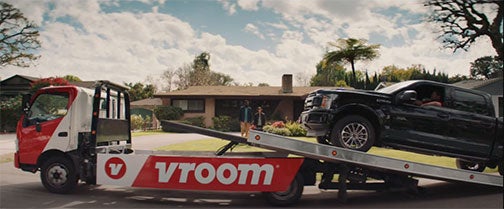
Online sales only accounts for 1% of all used car transactions, but this final frontier of ecommerce got an unexpected boost from the pandemic. And Vroom, an ecommerce platform for used cars, is revving up to catch the attention of consumers who want to buy a car – just not in person.
“This crisis has made our business model more relevant than ever,” said Vroom CMO Peter Scherr. “The crisis has been a catalyst that will prove that ecommerce is a viable and growing option for car buyers and sellers going forward.”
The number of people willing to buy a car online recently doubled, from 32% to 61%, according to a CarGurus survey in April.
Vroom already had executed a Q1 TV campaign before the pandemic, but its new messaging, slated for Q2, had to wait as the coronavirus took hold across the United States. Instead, Vroom’s digital messaging emphasized that it’s always offered ecommerce car sales, even as rival car dealers tried to develop their own contactless purchase strategies.
“We felt like it was not a great time to release this campaign in the marketplace,” Scherr said. “We wanted to remind the customer that we’re open for business, here to serve them, and most importantly, that Vroom has always been delivering cars to consumers nationwide.”
The coronavirus presented logistical challenges. Ecommerce sales declined 15% in late March compared to early March. Vroom had to cut prices to avoid inventory buildups, and temporarily furloughed one-third of its employees, according to a June S-1 filing.

Marketing took a hit too as the business regrouped. Vroom slashed $3.5 million in marketing costs through the end of May. In April, Vroom went completely dark on TV, before coming back in the middle of May with national TV, Scherr said.
Gearing back up
Having tackled the initial challenges of the pandemic, Vroom is resuming its long-term goal to build its brand.
When Vroom ran its first national TV campaign last year, it focused simply on introducing the idea of buying used cars online. Its 2020 campaign focuses on how the customer experience online is superior to one in person.
The new ad shows a person being accosted by aggressive (and non-socially distanced) circus performers, playing up the feelings of being overwhelmed, intimidated or pressured during a used car-buying experience. In contrast, Vroom offers “contact-free delivery” to your driveway and an online shopping experience.
Scherr doesn’t expect people will buy a car immediately after seeing an ad, and he instead focuses on brand awareness for TV initiatives, as well as actions such as visiting Vroom’s site or becoming a lead.
Most of the car-buying process already happens online – except for the actual purchase.
People often discover Vroom while they’re looking through car search aggregators such as Cars.com, Autotrader or TrueCar, Scherr said. Today, many of those search results connect people with one of the more than 40,000 car dealerships.
But post-pandemic, more of those deals may happen start to finish online, and local car dealers won’t have an edge there. “We don’t view [local car dealers’] efforts to create an ecommerce model as even remotely close to what we are delivering,” Scherr said. “The degree to which people do not want to go spend three to four hours transacting in person at a crowded local dealership has given us a tailwind.”








