

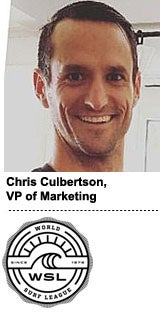
As the governing body for professional surfers globally, the World Surf League (WSL) promotes the sport to both casual fans and diehards.
But just a few years ago, the WSL – at the time called the Association for Surfing Professionals – lacked a cohesive marketing strategy, and campaigns for different surf events were heavily siloed.
“Before the rebrand [in 2014], all of the major professional surf events throughout the world were run by big surf brands like Quiksilver, Billabong, Rip Curl and Hurley, but it was a very fragmented business because there was no single owner for the brand,” explained Chris Culbertson, VP of marketing for World Surf League.
That strategy has shifted significantly as the global surf organization took the reins on marketing and taps into data to create direct-to-consumer connections.
Culbertson spoke with AdExchanger about its approach.
AdExchanger: What’s the World Surf League’s top marketing challenge?
CHRIS CULBERTSON: I started five years ago as the first person on the marketing team and there was very little research and understanding of surfing as a media product at the time. There was a lot of information about people who liked to buy board shorts and T-shirts, but there was very little insight into who was actually watching the sport.

Previously, if Quiksilver was hosting an event and the next event was sponsored by Billabong, for instance, a brand would have been more likely to promote their one-off marketing exercise than the next [surfing] event in a tour. There was a huge opportunity to improve efficiencies and create this single way to promote the sport and consolidate these decentralized properties into a single, digital-first global sports league.
Where did you start?
The first thing we did was dive into consumer segmentation research and started capturing insights using data and analytics through digital platforms to understand who was really watching competitions, how they’re behaving, what they like and don’t like, the motivators and barriers to build out a larger growth strategy.
What was the toughest part?
Understanding the real size of the consumer market opportunity. There was a lot of ambiguity and a lack of current, reliable data, so we had to make a lot of guesses and assumptions based on historical data.
The second challenge was bringing the consumer along and gaining their trust. Surf fans can be really skeptical of big organizations or “the man,” if you will, so there were some concerns and paranoia about how the sport would be treated. It was really important that we brought the fans along so they became part of our family and group.
What’s unique about surfing from a marketer’s standpoint? How is it different than, say, marketing football?
We don’t know when we will necessarily run an event. We’ll host an event over a two-week window and during that two-week window, we’ll probably run four to five days and it’s really dependent on weather, wind and wave quality. So the commissioners look at the conditions every morning and decide if they run or not. We don’t typically know until 15-20 minutes before an event that it’s going to happen that day.
Imagine the head of marketing for NFL not knowing until 15 minutes before the coin toss whether they’ll play a game that day. Because of this, we absolutely had to connect with our fans through digital channels and create a one-to-one connection in real time to let them know what was happening with competitions.
How has that reality changed your media investments?
We had to be able to distribute our content through our digital channels, including our website and, later, our app. It’s also really hard to do TV deals when you can’t tell broadcasters when you will run an event or how long you will run an event, so we leaned heavily into social platforms like Facebook, Twitter, YouTube, Instagram and Snap right off the bat.
What about your tech investments?
About five years ago, we went through a dating period with a number of different analytics platforms and, after about a year, we decided Google Analytics 360 would be the platform with the most flexibility, knowing we were moving toward being a big distributor of video.
As we kept building more tools and toys like our mobile apps and connected device integrations, we kept feeding all of the data into Google Analytics and, about two and a half years ago, I found myself looking at Facebook and YouTube analytics, pulling in what I could from Instagram and Twitter and ads [data] from 15 different sources. All of these spreadsheets and information were kind of spread everywhere.
What was your business need?
We needed a way we could triangulate around all of that data, but there had to be this consolidated view. Our partners AnalyticsPros introduced us to Google’s BigQuery, which is where we could pull all of the data into an unstructured data lake with Google Analytics at the core of it.
So you’re creating your own attribution play in a sense.
We started to pull all the data into BigQuery from Facebook, YouTube, Twitter, Instagram, ad-serving partners – anywhere we felt we could inform strategic business decisions if we had that social data, as well as behavioral data from fans.
In many cases, you can’t understand within the walled gardens how the consumer behaves across those platforms, but what you can see are different variables that match up – such as time a certain campaign ran. Then there are looser variables you can match up that allows us to get a sense for how our fans are behaving in all these different places based on what’s happening with our products and marketing plans.
Why didn’t you go with a marketing cloud or more traditional data management setup?
I think for a traditional marketer or ecommerce company or retailer, [marketing clouds] have a framework set up that’s probably really easy to work in, but being an unpredictable digital media and sports-focused business, we needed a little more flexibility.
Those platforms are great if you have a large-scale marketing budget and this ability to go out through a bunch of third-party ad networks, but we have a pretty well-focused and targeted paid media effort we run internally and we’ve already identified the platforms where we can uncover the most efficiencies.
We didn’t think we had the budget or need to leverage a DMP in the traditional way, so we wanted to build something that makes sense for us versus take something they already built and back it into what we need.
Interview condensed.








