

Facebook may be sidling away from ad tech, but it’s cozying up to marketing automation through a smorgasbord of APIs.
At its F8 developer’s conference in San Jose this week, Facebook rolled out the next version of its marketing API suite, which includes new tools to automate creative production and targeting parameters. Those APIs make it easier for developers to create, manage and measure campaigns on Facebook. The easier it is to use them, the more advertisers are likely to spend.
Netflix, for example, has been using Facebook’s marketing APIs to build a custom solution for its in-house programmatic marketing team.
The streaming platform added 19 million net new members last year, bringing the total to 98.8 million subscribers overall.
To sustain that level of growth, Netflix maintains a sizable marketing budget – just shy of $1 billion in 2016. But it doesn’t have all that much human capital to spare. The company has 4,000 employees globally, and only 31 people on the programmatic marketing team.
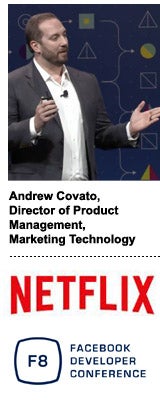
“To get the kind of leverage that we need on those folks who are executing our marketing campaigns, we need to develop a suite of automated products,” said Andrew Covato, director of product management for marketing technology at Netflix.
Within the last year, Netflix embarked on building what Covato referred to as a “marketing machine.”

Over six months, four Netflix engineers were able to build a suite of custom in-house buying and measurement products on top of a combination of Facebook marketing interfaces, including the ads management, ads insights and lift APIs.
The integrations have been a particular time-saver for Netflix, which brought all of its automated media buying in-house around four years ago and continuously tests and iterates.
“Netflix is a very test-heavy culture,” Covato said.
Using a cocktail of Facebook marketing APIs, Netflix developed a tool that helps scale management for A/B and lift tests by enabling programmatic managers to quickly set up test campaigns that adhere to the many best practices the brand has developed over time.
“When we’re able to do that, we’re able to really supercharge our testing road map and create iterations on the same campaign so we can determine what the best practices are,” Covato said.
Netflix also taps the marketing APIs to dynamically create thousands of ad versions per week, automate Custom Audience creation and audience suppression for existing subscribers and ingest ad metrics into its business intelligence system.
Going in-house means going “all-in,” Covato said, to dedicate time, effort and resources, but brands that take the plunge don’t have to create everything from scratch.
“The point of bringing things in-house is to build a custom solution tailored around your specific business needs,” he said. “But you don’t need to reinvent the wheel. There is a lot of great software that exists out there.”









