

 More marketers are adopting data-driven tactics by blending their own first-party data with third-party sources.
Financial services, for example, is undergoing major digital disruption, and banks are looking to translate direct-to-consumer marketing tactics to business constituents.
Capital One seeks to reach small and medium-sized merchants nationwide through its small-business division and does so using Salesforce as its hub for CRM data and as a point of integration for third-party data platforms.
It combines first-party data, third-party segments it imports through Acxiom and Facebook audience/location data to target business owners in key geographies.
“We spend a lot of time pushing data and running tests with a lot of vendors, and this integration lets me push out to Facebook, LiveIntent, Viant and other partners we’re working with,” said Matt Lattman, senior business director for small business bank marketing at Capital One, during a customer panel at Salesforce’s digital marketing event Connections in Atlanta.
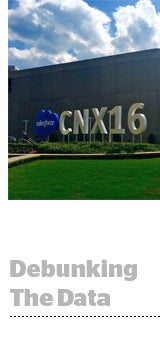
Though Salesforce is known to draw flocks of sales reps and IT systems integrators to its shows because of its legacy CRM business, Lattman was among many data-driven marketing stakeholders to show up in Atlanta.
Capital One aims to create a cross-functional “conversation” with target merchants across email, display and even in-store when they want to come in and talk to one of its bankers. Capital One looks to display as a means in which to find a consumer in the context they choose.

If that happens to be a business owner who’s in travel mode, that may include an email or display ad in a travel publication, whether through its LiveIntent partnership or Time Inc. and Viant.
“The platform lets me target direct moments [using display], whereas Facebook is where you already spend a lot of time,” said Lattman, “so that might be more customized [to that native environment].”
Luxottica Revamps Its Data Strategy
Luxottica Group, the owner of popular eyewear brands and stores including Ray-Ban, LensCrafters, Oakley and Sunglass Hut, began to overhaul its email and campaign management systems about two years ago in order to support a multibrand strategy.
The company hired Ryan McGuire, dunnhumby’s director of loyalty and rewards, at about the same time to lead selection and implementation of key campaign management tools.
Sunglass Hut was one brand that had a particularly massive email deliverability challenge, meaning targeting wasn’t so much of an issue as actually getting email into the consumer’s inbox.
“We were in Gmail jail at the time and the partner we worked with didn’t provide the information we needed, so we did a mini RFP and migrated over to Salesforce within six weeks,” said McGuire. That project was sizable, since Sunglass Hut was sending out about 300 million emails at the time.
“We really took a crawl, walk, run approach,” he added. “First, we figured out how to get email into the inbox and solved the problem of people opening email on different devices. 2015-2016 was a real step-on-the-gas year for us as we realized the sales incrementality coming from email. It used to be about 5-10%, but now it’s close to 30%.”
Now Luxottica is looking beyond email, which is challenging in its own right because the purchase frequency of its products is relatively low. Even very loyal brand customers will only buy so many eyeglasses in a year.
One way Luxottica has expanded its lens on new customer acquisition is by running lookalike models on Facebook and Twitter using Salesforce’s Active Audience tool.
Luxottica brand LensCrafters ran a successful campaign six months ago by targeting consumers via Active Audiences with an “Eye Exam Reminder,” since it determined there was a high correlation between the time someone had an eye screening and the time they made a new purchase.
But Luxottica also sees value in pushing the boundaries of first-party purchase and demographic data with third-party data sources.
“CRM can add a ton of value, but most retailers will tell you it’s a balance between maintaining existing and finding new customers,” McGuire said. “We’re starting to look at other POS and third-party data we can link to customers beyond their purchase and demographic data.
“If we’re doing a good job retaining existing customers, we’re also looking at how do we leverage that insight toward recapturing the inactives.”







