The programmatic supply chain might not be fixable, but that doesn’t mean publishers shouldn’t try.
Especially now, when they’re facing what Danny Spears, COO of publisher alliance Ozone, describes as a “perfect storm” of macro pressure, signal loss and traffic dips.
“There’s something unique about this moment,” Spears says on this week’s episode of AdExchanger Talks, “the magnitude of those challenges and the extent to which they’re all coming at the same time.”
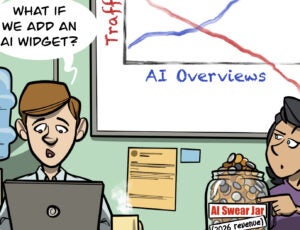
Cautious marketers are steering more money into performance and the walled gardens, while publishers are juggling Google’s Core updates, AI-driven changes to search and declining referrals, all of which have a direct impact on revenue.

Ozone was founded in 2018 by a group of major UK news publishers, including The Guardian and The Telegraph, at a time when margins were already under intense pressure – and AI search wasn’t even on the radar yet.
The idea, Spears says, is to give premium digital media brands a way to pool their inventory and data so they have more leverage in a market dominated by platforms and what he refers to as “corrosive intermediaries,” as in middlemen “solely focused on margin reallocation.”
These companies, he argues, “do a good job of taking money from publishers and moving it into the pockets of intermediaries through various schemes to reward their customers.”
“It’d be naive or even irresponsible for us to dance around that,” he adds.
But Spears is equally adamant that publishers aren’t helpless, far from it – and many are experimenting with innovative ways to push back.
At one end of the spectrum are large players like the Daily Mail, an Ozone member, which Spears cites as an example of a publisher investing in the “premiumization” of its user experience, as well as in building more creator-style programs to extend its influence off-platform.
At the other end are smaller operations, like Our Media, also part of the Ozone community, that Spears says “rewired its strategy” away from a pure dependence on Google SEO and toward distribution on third-party platforms. Today, he says, Our Media is “one of the biggest providers of content to Apple News.”
These are just two examples of many that illustrate the broader point, Spears says, which is that publishers might not be able to control the entire supply chain, but they can control how they distribute their content – and who they work with.
It’s undeniable that publishers create a heck of a lot of value, Spears says. The question is how much of it they get to retain versus having it extracted.
“That consideration is critically important for the future of sustainable journalism and content creation,” he says.
Also in this episode: What healthy supply-side optimization should look like for buyers and sellers, Ozone’s US expansion, why platform-centric attribution makes it harder for publishers to prove their value and what Spears (kind of) has in common with Billy Elliot.
For more articles featuring Danny Spears, click here.