Verification is moving beyond its traditional role as a protective shield.
In today’s digital ad market, advertisers need to do more than avoid bad placements.
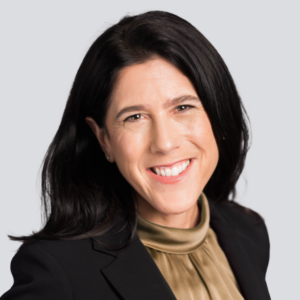
They want clear evidence that verification drives performance – which, increasingly, means demonstrating that premium placements move the needle, says Lisa Utzschneider, CEO of verification provider Integral Ad Science, on this week’s episode of AdExchanger Talks.

“We view media quality as an engine for growth,” Utzschneider says. “What we hear consistently from brands is, ‘Prove to us that media quality drives higher ROI and higher efficiency.’”
To do that, IAS leans on models built to classify video, image, audio and text at massive scale, including within the walled gardens. Across Meta, YouTube, et al., for example, IAS processes around 70 years of digital video content a day.
“It’s a tremendous volume of content,” Utzschneider says, and IAS uses it to train its models to more accurately distinguish high-quality media from low-quality media.
But defining “quality” is getting trickier as AI-generated content – and in some cases straight-up slop – competes for the same impressions as premium media.
Meanwhile, even seemingly clear signals like engagement can be misleading proxies for quality. Just because someone watches all the way through a video, for instance, doesn’t mean it’s necessarily the type of content a brand wants to be near.
In other words, verification has to keep up with how quality is defined and measured, especially as AI models pump more content into feeds every day. Utzschneider is bullish that IAS’ AI investments will help it stay ahead of the curve, and she’s blunt about what will happen to those who don’t move fast enough.
“I think that companies that are not truly investing in AI … will be left in the dust,” Utzschneider says. “It’s disrupt or be disrupted.”
Also in this episode: The benefits of being a private company again (IAS was taken off the public market by PE firm Novacap in December); the rise of AI agents in ad tech (they’ll be table stakes soon); and what “Utzschneider” means in German. (It’s kind of awesome.)
For more articles featuring Lisa Utzschneider, click here.