
Here’s today’s AdExchanger.com news round-up… Want it by email? Sign up here.
An About-Face
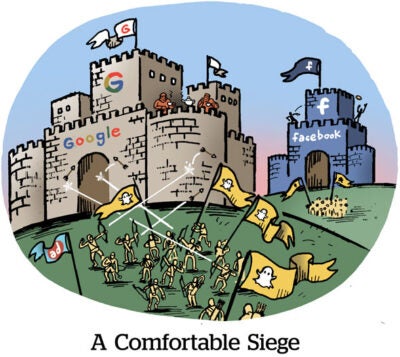
Six years ago, Google and Facebook had won the digital ad market, or so said Stratechery’s Ben Thompson.
After Meta’s latest earnings, he reflects on that prediction: The duo did consolidate most online ad revenue. And Google has outgrown everyone else to a shocking degree. Five years ago, Google was the 400-pound gorilla with $26 billion in Q4 2016 revenue. Last week, Alphabet reported $76 billion for Q4 2021.
Thompson did overstate Facebook’s strength, though, he writes today.
Ad platforms aren’t created equally. Google’s and Amazon’s search-based advertising can’t be disintermediated by Apple.
Amazon’s purchase data means it doesn’t need an SDK network and millions of user opt-ins across thousands of apps to spin the attribution flywheel.
Google’s site-to-site tracking is less hampered by Apple, too, because Apple’s strict tracking rules loosen within browser apps, which apply their own privacy policies – a point of bitter contention for Meta.
Facebook must recreate conversion attribution to kickstart direct response ads. But it’s a tough lift.
“While [Facebook] is better positioned than anyone else to build a replacement, it is important to note that the impairment entailed in probabilistically measuring ad effectiveness instead of deterministically is a permanent one.”

Begging For Change
The IAB warns of a “measurement blackout” if the industry doesn’t wake up and smell the roses already.
There were press releases galore last year about first-party data solutions. But did anything change?
“While first-party data was what everyone talked about non-stop in 2021, surprisingly it’s spending on third-party data that actually continues to grow,” according to the IAB’s annual State of Data Report.
Two-thirds of advertisers are not adjusting their measurement strategies this year, per the survey. Nearly 60% aren’t increasing first-party data investments. Third-party data is growing.
Never underestimate the joint powers of inertia and laziness. However, when Google Chrome announced last summer that it would delay the deprecation of third-party cookies from now – we ought to be in a post-cookie world, by the initial schedule – to 2024, it took the wind out of the sails for post-cookie investments.
Fewer than half of ad tech and publishing execs are familiar with the Chrome Privacy Sandbox or The Trade Desk’s Unified ID 2.0. The IAB Open Measurement SDK, its post-cookie initiative, has 15% adoption, according to the report.
The IAB is hoping to reignite a sense of urgency. “Advertisers trust that publishers and ad tech will find workable solutions, but it simply isn’t happening.”
Binge And Splurge
For a time, Netflix’s binge-watching was the apparent future model of TV. Releasing one episode per week in a given time slot has a quaint, old-fashioned vibe by comparison.
But now it seems Netflix’s challengers are happy to leave binge-viewing habits alone and stick with their tried-and-true episodic content, The Information reports.
For one thing, they just can’t afford it. Netflix spends way, way more on production than Disney, HBO or Comcast/NBCU on their streaming services – those three combined barely outspend Netflix.
But the drip-drip of new episodes is a boon to marketing and promotions. A show released on Netflix might see a tidal wave of viewers, but doesn’t bring reliable high tides throughout the year.
Non-Netflix services also suffer from churn. If a show’s whole episode list is available, people watch that one program then ditch the subscription. If they can hold viewers around for a few months, streaming services might escape the vortex of one-month promotional sign-ups and improve retention.
And audience engagement benefits from collective weekly viewing. Hit shows on HBO, AMC or other episodic streamers spawn podcasts, Twitter communities, Reddit channels, etc., all built around the weekly episode drop.
But Wait, There’s More!
IDG Communications acquires B2B lead-gen tech Selling Simplified. [release]
Snap acquires a minority stake in Aleph Group, its exclusive ad reseller in 39 emerging markets. [release]
Crain Communications takes a 20% stake in sports industry B2B publisher FOS, valued at $25 million. [Bloomberg]
Understanding Google’s post-FLoC pivot to Topics, and bidding without audience targeting. [Triscari’s Substack]
PriceRunner sues Google for $2.4 billion, alleging Google hasn’t updated shopping search practices since a 2017 antitrust decree. [Reuters]
You’re Hired!
Food52 makes five executive hires to meet new commerce publishing ambitions. [release]
Ogury appoints industry vet Geoffroy Martin as COO. [release]
Horizon Media names Mark Capps as EVP, managing partner of business solutions. [release]









