
Here’s today’s AdExchanger.com news round-up… Want it by email? Sign up here.
Bing Chat Is … Weird
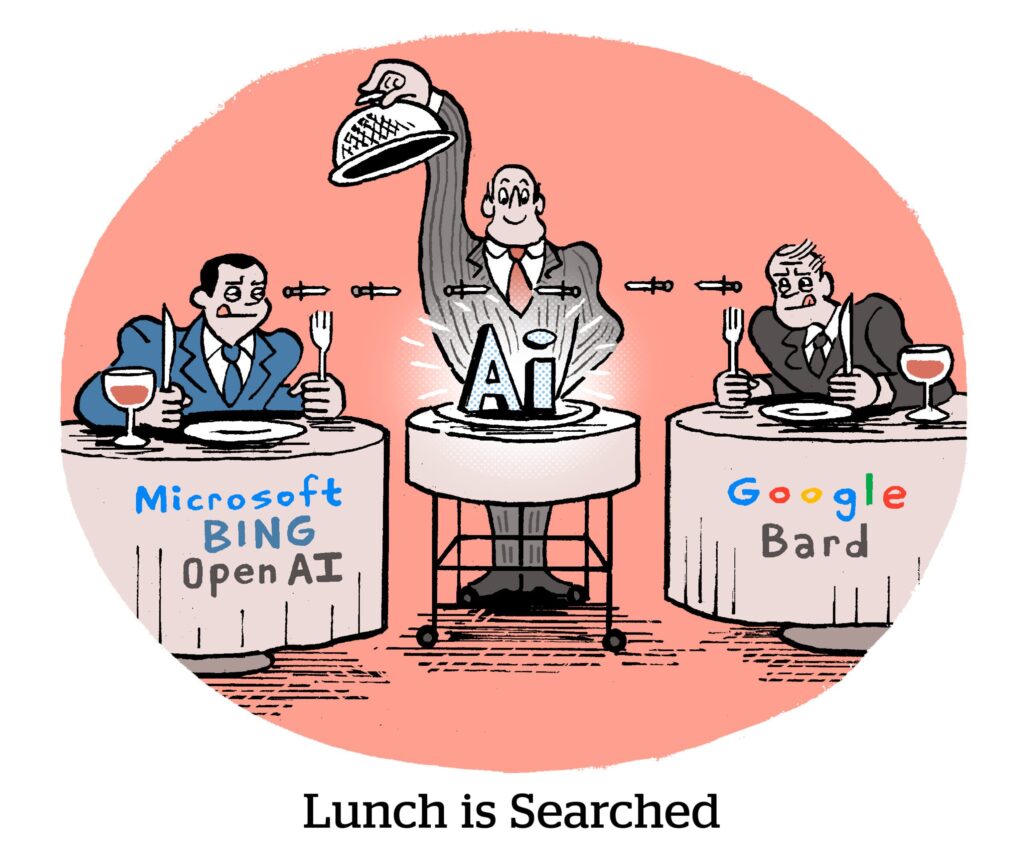
Microsoft’s AI-enabled Bing search is making waves for all the wrong reasons.
In early tests, the new Bing produced unhinged results that ranged from an aggressive know-it-all who’s constantly wrong to a jilted lover … to a robot with existential dread like in an Isaac Asimov story (or Bender from Futurama, for the less literary). In one unsettling instance, Bing said it spied on Microsoft programmers through device cameras to manipulate them during its development.
The machine learning search bot is clearly not ready for primetime – but that’s not stopping Microsoft. Its ad unit is already pitching at least one agency on paid ads for its new plaything, Reuters reports.

Microsoft reportedly showed off a demo that inserts links akin to traditional search ads into Bing’s AI-generated responses. And Microsoft is also testing ads that would surface alongside robo-Bing’s answers to questions, such as “What are the best hotels in Mexico?” (which is to say, queries with strong direct consumer intent).
By weaving ads into its chatbot’s responses, Microsoft perhaps hopes to allay advertiser fears that search ads will become less valuable once chatbot interfaces take over the key real estate at the top of search result pages.
It’s Not Easy Being Green
GroupM partnered with Scope3 on a carbon calculator that rates emissions across 11 channels, including TV, OOH, print, digital and audio.
GroupM’s methodology attributes greenhouse gas efficiencies based on Scope3’s data, which connects data and electricity consumption to the online advertising supply chain.
GroupM and Scope3 are also planning an API integration that would add emissions to the “classic” media plan, Kieley Taylor, GroupM’s global head of partnerships, told AdExchanger. Clients and media owners will be able to see the “hot spots” of emissions within their supply chains.
Advertising generates a substantial carbon footprint, considering all the intermediaries involved and all those server pings, and companies increasingly want climate impact reports. It’s good for business – and for your brand image – to be able to tout your low green bona fides.
WPP, GroupM’s parent company, set a benchmark to reach net-zero emissions by 2030. GroupM accounts for more than half of WPP’s overall carbon footprint.
SCOTUS v. UGC?
Today marks the first day of hearings for a US Supreme Court case, Gonzalez v. Google, that could have major ramifications for Big Tech companies – and advertisers.
The case puts to the test a legal shield called Section 230, which protects internet service providers and other major online consumer hubs from liability for things individuals or third parties do or say on their platforms.
Telcos, for example, aren’t liable if a criminal uses their mobile service during the commission of a crime.
For Google and major social media platforms, this case litigates whether that same protection applies to the user-generated content they distribute. The case was brought by the family of someone who was murdered by militant Islamic State terrorists who were radicalized, at least in part, by YouTube videos.
What does this mean for the ad industry?
“So much of advertising is now being delivered in a dynamic way,” UC Santa Clara law professor Eric Goldman tells Bloomberg. “If that dynamic assessment is an algorithmic recommendation that disqualifies the ad network for 230 protections, then the ad industry has to do something different.”
But Wait, There’s More!
The Trade Desk’s bumper quarter has some important caveats. [Digiday]
Why “inserts” (aka the ads slipped into packages) are having a moment. [Marketing Brew]
Ed Zitron on “degenerative AI.” [blog]
Facebook ran ads in Moldova for an oligarch sanctioned by the US government. [AP]
It’s time for agencies to stop giving category exclusivity to clients. [Ad Age]
Apple WebKit: Introducing Web Push for home screen web apps on iPads and iOS devices. [blog]
You’re Hired!
Media agency Cutwater adds Matt Allen as group account director. [release]









