
Here’s today’s AdExchanger.com news round-up… Want it by email? Sign up here.
Reach This
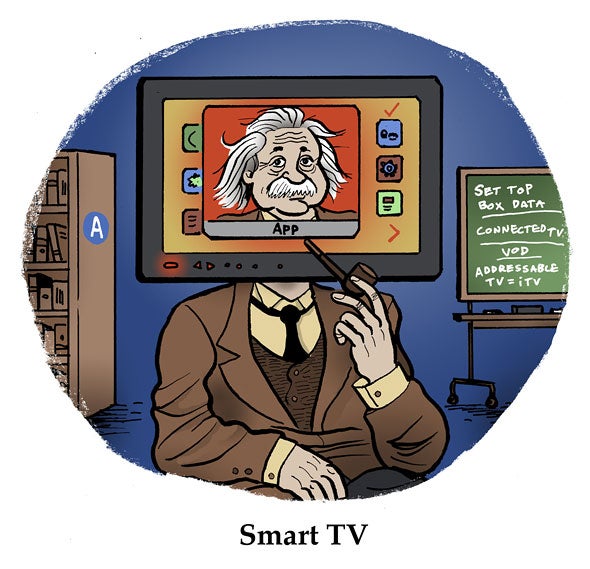
LG, Samsung and Vizio all love bragging about their respective reach.
But the trio does agree that smart TVs can unlock the scale and addressability marketers need to reach consumers with television ads.
Over half of US households own a smart TV. From the audience reach to the viewership data, “everything in the CTV space is addressable,” LG Ads Solutions CEO Raghu Kodige tells Forbes.
How? Automatic content recognition (ACR) data tracks what apps or shows are on the screen and can be used to guide or attribute media buys. Manufacturers can also install a proprietary operating system. Hence the rumor that Roku is mulling over making its own TV sets.
LG Ads Solutions is “used to competition in the smart TV space,” Kodige says, calling out Samsung, Vizio, Sony, the long-tail of smaller OEMs, the newbies trying to enter the market and their mothers.
“It’s not scary or anything new,” he says. “In fact, it only validates our view that this space is getting bigger and becoming more valuable.”

The Advertising Hail Mary
Unibail-Rodamco-Westfield (URW), the biggest mall operator in Europe, debuted its turnaround plan this week to return to pre-pandemic growth and foot traffic levels. And at the heart of the strategy is a first-party data and advertising service.
“Until recently, the only thing we could see was how many people were entering and exiting our malls,” Jean-Marie Tritant, URW’s CEO, tells Bloomberg. “Now we have different sensors and we can use WiFi in a fully GDPR-compliant way to really understand who is using our assets.”
The company has a media business that made 30 million euros in 2021 (about $33 million), and it’s forecasting around 75 million euros by 2024 and 200 million euros by 2030.
Those aren’t huge numbers, but the ad platform is also part of helping URW convince tenants of the value of renting store space. The mall boasts some 550 million visitors. Although the mall operator won’t be running ads for brands and agencies (at least not yet), it will be serving targeted ads meant to drive foot traffic to stores in its retail space.
All Fun And Games
The in-game ad tech company Anzu.io has raised $20 million, bringing on investors, including NBCUniversal, Sony and WPP, VentureBeat reports.
In February, the startup announced a partnership with NBCU to allow the broadcaster’s clients to run in-game ads across Anzu’s inventory.
“Our advantage is technology and supply, and their advantage is demand,” Anzu Co-Founder and CEO Itamar Benedy told AdExchanger at the time.
Adding investment stakeholders is one way to secure strong, reputable intros and access to demand for a category that’s been mainly limited to in-game advertisers, such as other mobile games or apps, rather than major brands. Gaming has innovative tech, including dynamic in-game product placements, but not a lot of mainstream advertisers are aware.
But linking up with NBCU is an opportunity that also comes with risks. It will mean striking a delicate balance as Anzu charts a course that will no doubt include partnerships with non-Sony game studios, direct competitors to NBCU and other agency holding companies.
But Wait, There’s More!
Meta paid a GOP firm to malign TikTok. [WaPo]
MGID had acquired Italian native ad network Native S.r.l. [release]
Pop-up digital ads are taking over the freezer aisle. [Axios]
Marketers continue shifting ad dollars into CTV and OTT. [Digiday]
Disney expands its international plans for Disney Plus. [Variety]
You’re Hired!
Comcast vet Frank Deo joins 605 as EVP of engineering. [release]
Disney taps Google vet Jeremy Doig as streaming services CTO. [Deadline]








