
Here’s today’s AdExchanger.com news round-up… Want it by email? Sign up here.
Mind The Store
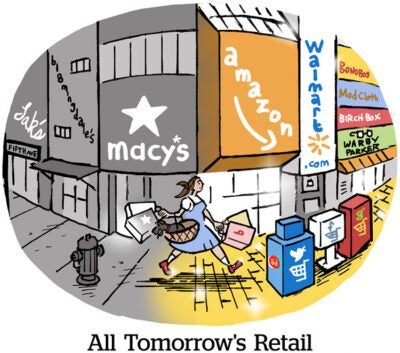
More brick-and-mortar retailers, especially department stores with real acreage, are carving out square footage in their stores for hybrid ecommerce fulfillment.
The idea isn’t new. Best Buy, Nordstrom and others have used stores as online shipping hubs for years. But the likes of Ulta Beauty and Macy’s are revamping stores with fulfillment capabilities as well, The Wall Street Journal reports.
Higher online purchase rates mean retailers must adapt.
“We recognize the consumer journey is no longer linear,” Amiee Bayer-Thomas, Ulta Beauty’s chief supply chain officer, tells The Wall Street Journal. “Ulta Beauty must provide shopping options that reflect how and where our guests want to engage.”
Understanding a store’s in-stock items is also a key data add-on for retail media networks. (Ulta, Macy’s, Best Buy and Nordstrom have all launched ad networks in the past 12 months.) It means product ads lead to out-of-stock items less frequently and convert more effectively with faster shipping and a store pickup option.
But online and in-store still get into turf (or sweater) wars. The problems with an integrated approach come when, say, a store associate goes to get the sweater someone bought online and a customer is trying on the last one in stock.

Can Twitter Fly With This Right-Wing?
Twitter is trying to win back advertisers who halted campaigns since Elon Musk’s takeover.
The company is dishing out massive promotional benefits for advertisers who’ll spend in December. And as soon as next week, Twitter will introduce account controls so advertisers can avoid appearing above or below tweets with certain keywords, Reuters reports.
That announcement follows close on the heels of a Washington Post report that approximately 40 advertisers, including Amazon, Snap, Uber and the US Department of Health and Human Services, appeared on the pages of formerly banned prominent white nationalist accounts restored to the platform by Musk. One such account belongs to Andrew Anglin, the editor of the Daily Stormer, a right-wing site known for pro-fascism positions and Holocaust denial.
Twitter’s efforts are unlikely to appease large brand marketers. The problem isn’t keywords, for instance. McDonald’s doesn’t want to appear alongside right-wing accounts or on account pages that promote violence and white nationalism, even if a nearby tweet is innocuous.
Marketers aren’t fully ‘out’ of Twitter, though. Many who stopped advertising are still using the Twitter pixel – they have organic activity there, after all, and haven’t permanently jumped.
Genuine Or Generated
The authenticity of influencers created a $16 billion global market. But the competition for creator partnerships has driven up influencer costs and sparked an interest in AI and automation – perhaps at the cost of authenticity.
Since well-known influencers are too pricey for smaller brands, brands are reallocating costs to “microinfluencers,” which they need automation to manage. The next step: “virtual influencers.”
Sometimes, low-follower creators can actually drive higher returns for advertisers, since they typically engage a more niche audience, says James Creech, SVP of consumer strategy at consumer intelligence company Brandwatch, to Digiday.
“Well-known influencers are great for generating buzz and awareness,” Creech said, “but niche content creators can often drive more action.”
Brands can attain similar results with self-generated AI influencers, he adds.
Clothing brand PacSun, for example, used an AI influencer named Lil Miquela in 2016, and Prada created a virtual muse named Candy, after its perfume.
But Wait, There’s More!
East Fork Pottery is negotiating the tricky transition from a founder-influencer-based social brand to a stable, mature marketing org. [NYT]
Content ideas may be coming to Google Search Console. [Search Engine Land]
The FTC is investigating crypto firms over allegations of misleading ads. [Marketing Brew]
Brands should be tapping actors on set for marketing tips. [Adweek]
Warner Bros. Discovery makes more leadership cuts as part of its network reorg. [Variety]
You’re Hired!
Hertz hires Wayne Davis as CMO. [Adweek]







