
Here’s today’s AdExchanger.com news round-up… Want it by email? Sign up here.
A Squeaky-Clean Apple
Apple was charged in the EU with boxing out wallet apps and payments, using its monopolistic power to force consumers to use Apple Pay, The Wall Street Journal reports.
Outside payment services particularly want access to one-touch or mobile contactless purchase tech.
Apple is already facing an EU probe for its App Store fees. As Apple’s attack on the advertising business (and growing ad business of its own) increases, its acts of self-preferencing could fall under tougher scrutiny.
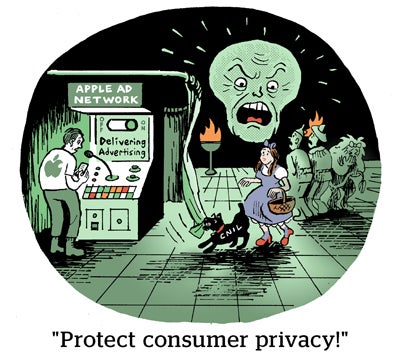
Apple’s own pop-up notification standards on Apple tvOS and the iPhone are a huge violation of its third-party policies – it doesn’t collect consent for direct marketing or promo offers and interferes with other app engagement all the time.
Apple gives itself default location data consent, but third-party developers must gain consent while using language about “tracking.” Apple’s ad platform frames its tracking request as “personalization” services. Other apps must again gain consent for “tracking.”
Apple also tries out new ad placements, creating ways to cross-sell Apple Music, Apple TV+, Apple News, Apple cloud data packages and more. It’s a practice that rival Big Tech company Amazon used for its private-label brands but has since discontinued.
The shield guarding Apple from an antitrust barrage is its popularity. Take Facebook down a peg, and it’s a future campaign commercial. Messing with Apple is a political liability.

Stand And Deliver
Instacart is in a bind.
The company cut its private market valuation by 40% this year to $24 billion. It’s a tough pill to swallow but one that makes sense considering publicly traded mobile tech competitors took similar valuation setbacks after Apple ATT fully rolled out. Instacart feels it doubly, since it’s a big ad seller and mobile acquisition marketer.
One idea backed by some stakeholders is for Instacart to open its own warehouses and sell directly to customers, The New York Times reports. Those sales would be more profitable. And the company needs every millimeter of margin if it’s going to add the cost of delivery to low-margin grocery sales.
CEO Fidji Simo apparently shot the idea down. That announcement would fly up the ranks of partners like Walmart, Target and Kroger, which all begrudgingly use Instacart. Target officially announced it would stop listing on Instacart after it acquired the delivery service Shipt in 2017. Five years later, Target’s still for sale on Instacart.
Simo’s plan (not shocking for a Facebook vet) is to ramp up advertising in the app and push its ad platform software to other grocery apps and sites.
Cleaning Up
The term “clean room” may describe privacy tech, but it has two things in common with “surveillance advertising” – it’s the talk of the town, and no one can decisively define it.
One day, clean rooms are data storage. The next, they’re analytics or even activation, Digiday reports.
Publishers are building clean rooms left and right to monetize first-party data. As with CDPs, many different kinds of companies have hastily repurposed existing products as “clean rooms” to sell the trendy term.
Every clean room differs – and some advertisers rely on clean rooms more than others.
Marketers who just want to get ads up and running have other (potentially cheaper) tools at their disposal. But marketers looking to better understand their audiences are dependent on the data hubs to glean insights from walled gardens or content fortresses (a choose your own jargon adventure!).
When it comes to data clean rooms, sometimes they may be necessary, and “sometimes the juice just won’t be worth the squeeze.”
But Wait, There’s More!
In-game mobile ads aren’t enough. Sony and Microsoft are racing to get ads in-game on Playstation and Xbox, too. [Insider]
Mike Shields: Can sports be Netflix’s savior? [blog]
YouTube and Paramount form an alliance ahead of this week’s NewFronts. [Adweek]
Wait … Facebook has a podcast service? Well, not anymore. [Bloomberg]
Speaking of podcasts, every brand and their mother has one now. [Morning Brew]
You’re Hired!
Adform makes John Piccone regional president, US; Julian Baring to lead global business development. [release]







