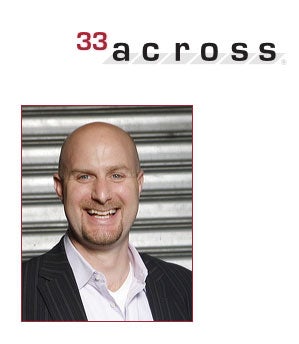
Eric Wheeler is CEO of 33Across, a social advertising technology company.
 AdExchanger.com: Any update you can provide on momentum at 33Across? Hey, what does the name, 33Across, mean anyway?
EW: We’re working with a number of major brands and media agencies – The 33Across SocialDNA™ platform enables marketers to identify and anonymously target people with strong real‐world connections to a marketer’s existing customers. These “Social Proximity™” segments are uniquely generated for a given marketer using social graph data from websites that partner with 33Across. The result is large, high‐propensity targeting segments consisting of people with similar interests and purchase behavior. The results are fantastic for both direct response and brand advertisers.
33Across is a crossword puzzle reference. Usually there is a long horizontal word in the middle of a crossword puzzle around 33Across that, when solved unlocks the rest of the puzzle. 33Across is the perfect metaphor for how we help clients and their agencies leverage previously untapped social data sets to solve their biggest marketing challenges.

Whose “challenge” is 33Across trying to solve: the social media publisher or advertiser?
We help both. Most advertisers are looking for effective and scalable ways to leverage the social graph in their programs. 33Across enables advertisers to utilize social data both within and outside of social networks to improve larger cross-publisher display campaigns. For publishers, we are an incremental revenue stream for the data we license.
Are their advantages to the ad exchange model that social media advertisers and publishers may be able to leverage?
The exciting thing about ad exchanges is the increasing amount of quality inventory that continues to become available. Using 33Across, marketers can use our Social Proximity segments to target users across the web via exchanges, not just within social media.
Can you identify the inherent difficulties of attribution related to media buying on the social web?
We’ve found that many of our advertisers have advanced attribution models that measure networks, rich media and advanced targeting side-by-side in there ability to drive direct and indirect (post click and post view) campaign revenue. Although there are few standards from one client to another, we do see similar approaches that help to provide apples-to-apples comparisons of different media and targeting in delivering on campaign objectives. Of course, attributing online activities back to in-store purchases or behaviors like TV tune-in is still very hard, but by working closely with the client and agency to integrate our data into more comprehensive views of cross-channel tracking we can start to measure the overall effect of social targeting as part of the total media mix.
How do you see real-time bidding within the exchange model playing out – a potential benefit to the social web?
The industry is continuing to embrace the use of custom data segments tied to real-time bidding on exchanges. The benefit for the social web is that they will no longer need to rely 100% on revenue generated from ads served within their network, allowing them to focus on being a best-in-class social tool and, in partnership with 33Across, using their social data to improve ad targeting across the web via exchanges and networks.
In general, how is the media agency model going to need to evolve? Will it need to be more entrepreneurial, for example? Or more technology-oriented?
Media agencies are going to continue to evolve in their ability to leverage data to deliver on client objectives and to drive ROI. Technology infrastructure, data management, predictive modeling and segmentation are all parts of the evolved media agency. Given the way in which most agencies are moving, I’d expect to see even more entrepreneurial units connected to large agencies sprout up that are rooted in technology, data and have a ruthless commitment to driving increased return for their clients. I call these evolved agencies Media T-1000‘s. They’re clearly media agencies, but they can do things you’ve never dreamed of before. We’re building custom tools, data segments and capabilities for them.
Is it all about addressable media now and less about the placement? Where does brand safety fit in?
With the growth of exchanges we’re able to construct high-value audiences fueled by predictive data models instantly. With Behavioral Targeting we moved from the page to the person. With Social Proximity Targeting we’ve moving further into understanding the social connections around anonymous relationships and are able to activate those connections across the web. This has as much value to brand advertisers as it does response advertisers. We’ve put in place advanced controls that ensure we deliver into brand-safe placements.
Do you see more or fewer ad networks and ad agencies in the future?
There will probably be fewer networks in the next few years as consolidation grows and differentiation becomes more critical. In the near term for agencies we’ll probably see more Media T-1000’s pop up inside, adjacent to and independent from large media agencies as new models in agency/client collaboration are developed.
What would you suggest to young, digital media planners in order to hone their skills as they plot a successful career in media?
Besides calling 33Across? They should get a broad understanding of search, data-driven display programs, and start working with exchanges to appropriately integrate available 3rd-party data to improve client programs. The media marketplace will continue to accelerate, in both the pace of programs and the sheer volume of data that can be used to improve return. I’d also suggest that they take every opportunity they can get to understand, present to and partner directly with their clients. Some of the best “account people” I’ve worked with were media planners. I’m not sure exactly how the entire agency and client landscape will evolve, but I’m confident that there will be much greater financial and operating alignment between agencies and clients going forward.
Follow Eric Wheeler (@EricWheeler) and AdExchanger.com (@adexchanger) on Twitter.