
 From Today’s AdAge article, “Media Giants Want to Top Google Results” by Nat Ives:
“You should not have a system,” one content executive said, “where those who are essentially parasites off the true producers of content benefit disproportionately.”
Load the cannons! Kiss the loved ones goodbye! This is WAR!
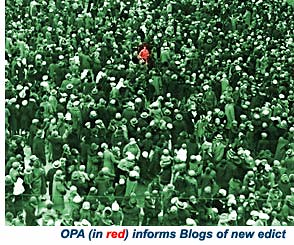
Premium publisher titans undoubtedly led by the stealthy Death Star of Demagoguery known as the OPA (Online Publishers Association) have inadvertently declared war on bloggers by suggesting to Google that their content is better and deserves better rankings on Google search engine result pages (SERPs).

Evidently, if we want to learn about Gaza, we should be consulting the reporters of the NY Times before we read a blog about Gaza from a Palestinian or Israeli. Well, I’m glad they told me what to think. Just saved me time from writing another blog post – NOT.
An unnamed publisher is quoted in the AdAge article:
“This would in no way mean that only professional content publishers would get an advantage,” one said. “It really just says that the original source, and the source with real access, should somehow be recognized as the most important in the delivery of results.”
But, of course. The NY Times is the source on Gaza. Thanks for the reminder.
Obviously traditional media sources are continuing to struggle with the Long Tail niche sites to which people are migrating for news and conversation. It appears publishers like the NY Times and ESPN want a “first class airport queue” so they can always be above the fold in the SERPs.
Peter Kafka on All Things D points out:
“If Google was somehow able to train its bots and spiders to suss out material that was truly original, it’s entirely possible that many of the big guys wouldn’t be happy with those results, either.”
Another one of the pain points of this strategy – putting down the Long Tail and blogs – is that many of those sites contain avid readers of these large publishers which are merely extending the large publishers content and reach. We’re not in favor of wholesale copying of articles – we’re in favor of letting people comment on whatever they see relevant to their social experience.
To suggest to Google that somehow their journalistic investment is somehow more worthwhile than bloggers and Long Tail sites, shoots newspapers and traditional media in the foot, once again.
These supporters of walled garden strategies need to open their brands to a new world where you share your brand and, consequently, you add value to your brand simultaneously. You give, you get.
Same holds true for ad exchanges.. if publishers allow insight on the publisher site’s media, they improve yield/CPMs as advertisers have better understanding of audience and campaign matches.
We do agree with our “premium friends” in one respect, though. Wikipedia is an unbalanced uber power on the search engine results pages with, at times, questionable information guarded by unqualified editors.







