 Facebook said on Friday it’s bringing back the conversion pixel to its online advertisers by the end of the month, after abandoning it in 2010.
Editor’s note: Up until now, there appeared to be exceptions made for some large advertisers who were using third-party ad tracking on Facebook – likely due to the size of their spend. (Ahh, the muffin pixel.)
At the time that conversion pixels were pulled from the FB toolkit in 2010, conjecture on “Why?” ranged from “data leakage,” to legacy Beacon concerns, to not wanting to support the Google display ad ecosystem – which includes pretty much anything beyond the Facebook login save for a few, well-known portals. “Make your landing pages on Facebook!” seemed to be the idea.
But, no more.

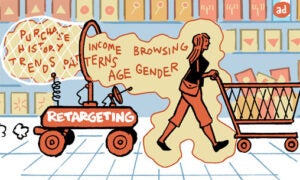
As Facebook burrows away at a mobile ad network strategy that may or may not proliferate to PC-based display, it was likely time to bring its direct marketing partners increasingly into the fold. The strategic shift echoes the partnership with retargeting companies who are now allowed to access Facebook cookies and audience through Facebook Exchange, and extract the benefits of Facebook’s one-of-a-kind scale and reach. Overall, Facebook appears committed to aligning with advertiser goals that happen on Facebook and off – i.e. landing pages.
Another example of the criss-cross of Facebook advertising strategy is the somewhat overlooked “Custom Audiences” product which seems like a CRM dream for direct marketers. Looking to map their offline data to online audience, the “Custom Audiences” product can allow an e-commerce marketer, for example, to take a list of all of their registered buyers – and assuming they have permission according to their T’s and C’s and privacy policy – map each registered user’s email to email addresses on Facebook. And then those email addresses are mapped to cookies that can be targeted on Facebook using its data.
Hypothetically, if you were registered on Amazon, Amazon could take your email and ask Facebook to match it to its database of emails that Facebook users use to access FB. Sure – everyone doesn’t use the same email address for Facebook as Amazon – but many likely do and that’s enough to provide a unique opportunity to address customer audience using the direct marketer’s first-party data (email, in this case).
Think of the implications here. Salesforce could offer its customers the opportunity to leverage CRM records and, assuming each record has an email (or phone numbers) with the appropriate permissions, retarget the user on Facebook. Acxiom, Experian, and Epsilon all get this. So do many others in the ecosystem – agencies, ad networks/DSPs, trading desks, etc.
Online-offline, across digital channels – the connective tissue includes the email and the pixel. And, conversion pixels are another example of Facebook’s quickly spreading, ad strategy as the promise of addressable advertising takes another step.