 Last week AdExchanger looked at the dynamic between ROI DNA, a performance-driven agency, and its preferred display-trading partner, Run DSP. (Read the story.)
There are many such relationships in ad tech, where a mid-sized agency relies on a key network or platform partner to drive ROI and provide hand-holding to its planners and buyers. You can find another example in the interplay between Denver agency Booyah Advertising and DSP/ad network Rocket Fuel.
Booyah has about 50 clients on behalf of whom it manages roughly $100 million in digital spend annually. Of the half that goes to display, 60% is programmatic. That makes $30 million in exchange-traded media.
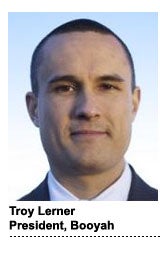
Booyah began working with Rocket Fuel three years ago, adding it to media plans alongside traditional ad networks and direct site buys. Booyah President Troy Lerner says, “I didn’t even know what I was buying.”
As the agency’s media buyers got more comfortable with the terminology of DSPs and RTB-focused ad networks, it tried some other similar partners, among them Turn and Invite.

Rocket Fuel performed well and won a larger share of Booyah’s spend. As Booyah ramped up, Rocket Fuel would usually get an I/O for $100,000 to drive leads for one of its several luxury travel customers.
“Rocket Fuel flat-out performs well. When we tell them we need $10 CPAs, they get it,” says Lerner.
Service
But others also performed.
Part of what Booyah valued was the technical expertise of the Rocket Fuel support team. “A lot can be lost in translation between that phone call and the machine operator. Rocket Fuel is able to respond really fast and do so with a high degree of accuracy,” says Lerner.
He also adds that Rocket Fuel is quick to identify and correct its own mistakes: “Not a month goes by where some partner didn’t screw something up. A $1 bid turns into $10 bid. We have to bust somebody. Rocket Fuel is the only vendor I’ve ever had that proactively catches themselves.”
Rocket Fuel President Richard Frankel says, “The service layer is unbelievably important here at Rocket Fuel. Clients don’t want to do business with companies that are black boxes.”
Results
Booyah was willing to share results for a few clients.
For one luxury travel client in the ski industry, Booyah says Rocket Fuel drove a 62% higher ROI than the second best-performing network and 264% better ROI than the third best-performing network.
For Blockbuster, Rocket Fuel drove 44% more efficient cost-per-action than the next closest competitor.
And for luxury travel company Inspirato, Rocket Fuel helped Booyah meet a goal of turning 2% of leads into customers.
A recent study by Forrester (commissioned by Rocket Fuel) found the company drove average ROI of 229% for agencies measured over a three-year period. For individual clients, the average ROI was somewhat lower (192%), outperforming a sampling of ad networks by 144% and an unnamed demand-side platform by 60%. Rocket Fuel’s negotiated CPMs were higher, however, by about 20%.
Trading Desk
As Booyah ramped up its display media spend, the company decided to add its own trading desk capability (AdExchanger story). Rocket Fuel was not in the running for that, since it didn’t offer a licensed dashboard product for which Booyah could be charged a platform fee. Booyah went with Turn DataXu [An earlier version of this story misstated the DSP].
But it continues to leverage Rocket Fuel. Lerner says, “I still don’t consider myself yet a competitor to what they can do. I would not pit myself in-house against them.”
Rocket Fuel’s Frankel says of Booyah’s approach, “They are not afraid of change. They are very rapid learners. They have invested tremendously in Rocket Fuel – their time, energy and attention. That’s what the best agencies do.”
Rocket Fuel has found considerable success with agencies like Booyah – big enough to be sophisticated but, as Lerner puts it, “not so big that we want our trading desk to crush them and take them out of the market.”
“I think that middle market is kind of underserved,” he says.
Definitions And Revenue Models
Even in the age of real-time display media trading, a lot of business is transacted via insertion order. So the new breed of digital ad company – Rocket Fuel, Media IQ, Digilant, Accordant Media – are often purchased just as ad networks are, with an I/O, though they may have no publisher contracts.
Frankel will not let Rocket Fuel be pigeonholed as an ad network or platform company. Asked if the company ever uses a SaaS revenue model versus one based on margins, he says, “We have an interface for customers to use.”
“Customers buy us in a lot of ways,” he adds. “Some customers think of us as a network, some as a DSP. The direction is more as a general solutions provider, and that’s why these buckets don’t mean so much.”
If Frankel is correct that agencies don’t care about buckets, clients are that much more indifferent. But they’re now asking for meetings with Rocket Fuel based on the volume of spend showing up in their agencies’ media plans.
“When you’re a $10k test on a complicated media plan, they don’t want to know much about you,” says Frankel. “When the spend gets into the millions, they decide there’s something going on here. They want to know more about you. “