RSS FeedArchive for the ‘Ad Networks’ Category


New Mobile, Affiliate Units at CPX Interactive Aim to Capture Fragmented Spend

CPX Interactive was founded and long run as a traditional ad network business, but it wants to be known for multi-channel advertising -- a la ValueClick. So it's breaking out its channel offerings into branded divisions, starting with mobile and affiliate ads.

Its new mobile network, Moversa, is three months old but already contributes 5% of CPX's annual revenue of approximately $60 million. The freshly minted affiliate unit, Affiture, adds about the same amount, says CEO Mike Seiman. That doesn't necessarily mean the overall business has grown 10%, since both mobile and affiliate previously contributed revenue to CPX Interactive. But Seiman tells AdExchanger some of it is accretive.

"As we looked at the landscape and saw a lot of companies budding out into these individual disciplines, we've realized a part of our fault over the past few years has been not really marketing all of our services separately and breaking them out as subdivisions," he said.

(more...)


What Would a Facebook Ad Network Look Like?

Facebook Ad NetworkFacebook is keeping the door open to an ad network. Its recently updated Data Use Policy says, "We may serve ads, including those with social context (or serve just social context), on other sites."

But "may" doesn’t equal "will." In conversations with AdExchanger, Facebook observers place bets on if and when Facebook will launch an ad net - and if so, what it should/could/will look like.

Near-Term Priorities Don’t Favor an Ad Net Strategy

David Fischer, Facebook’s VP business and marketing partnerships, recently gave a stock response to the ad network question. "We're not working on anything like that now," he told the crowd at AdAge’s digital conference. Of course Google said the same thing about behavioral targeting – until it began offering behavioral targeting. And Yahoo said it about selling its search business – until it sold its search business.

But there are good reasons to think Fischer told the simple truth: Facebook is not developing an ad network at this time.

"I don't have any doubt that Facebook could power a network on the open web, and that it would be a great product, but I don't think they will," said Adam Cahill, EVP, co-media director at Hill Holiday. "My sense is that their entire premise as it relates to advertising is that the banner-based model the web has grown up on is fundamentally flawed. I think their focus is strictly on creating what they think is a new and better way to do advertising, and that this will happen within the walls of Facebook, where it can be controlled and monetized."

Cahill continues, "There’s a lot of talk lately about the idea of ‘native advertising,’ and I think Facebook is focused in this direction, not on making ads on the open web marginally better."

(more...)


Divining The Optimal Marketer Outcome With Audience Targeting

Data-Driven Thinking"Data-Driven Thinking" is a column written by members of the media community and containing fresh ideas on the digital revolution in media.

Today's column is written by Michael Katz, VP II, Optimization & Analytic at Yahoo! and former CEO of interclick, a Yahoo! company.

Data is everywhere. There are iconic ecosystem slides dedicated to it. Billions of dollars in capital have been invested to make sense of it all. As a result, we have seen maturity to the point of hyper-specialization and very attractive exits. But even with all of the advancement, we still haven’t solved the billion dollar problem of determining which drives the most optimal marketer outcomes. It’s the reason certain media dinosaurs dismiss data, targeting, and analytics all too quickly. Solving this problem requires completely new thinking about the challenge.

It’s important to start upstream and look at the digital media planning process, where the problem originates. The way digital media is planned is archaic; it is based on the way that traditional media has been purchased, where consumer data capture is extremely limited. Popular planning and measurement tools leverage demographic data to describe audiences that index high on certain sites and while this information is directionally helpful, these tools fail to address the challenge properly.

To highlight this, take a look at pretty much any RFP sent/received. There is a good chance that the target audience defined on the RFP leverages demographic targets (i.e. Males 25-54, HHI $100k+). Simply put, the problem with this is that not all consumers who look alike will act alike. So these targets represent placeholders and it is left up to the vendor to figure out who to target. As such, billions of dollars are wasted in media every year because we are applying an analog approach to a digital problem.

A number of different audience solutions attempt to address this problem. We can separate them into four categories.

(more...)


What Counts as ‘Scale’ in Hyperlocal? Mobile Ad Players Weigh In

hyperlocalIs hyperlocal inventory getting easier to come by? The rate of smartphone ownership in the U.S. (106 million as of March, by comScore's count) suggests yes, but many say it’s still tough to amass significant reach for highly geotargeted campaigns.

AdExchanger tapped several companies that are focused on this problem to answer the question, “What qualifies as ‘scale’ in hyperlocal mobile advertising?”

Click below or scroll to read their responses.

Alistair Goodman, CEO of Placecast:

"We see scaled media delivery in the mobile context as the ability to reach a high percentage of a target audience in a mindset to make a purchase, ideally when they are near a store. In mobile today, we’re beginning to see the emergence of many different ways of doing this but we're still in the early days. Mobile search and display through Google, AdMob, Quattro and others are offering geotargeting, but it’s currently not granular enough to achieve real scale - most small businesses want local targeting that can be broken down by neighborhood, or a program that can place geofences around several blocks.

Additionally, only a small portion of display inventory available for purchases on exchanges today actually has usable, granular location – and most SMB’s wouldn’t even know where to start to buy this inventory. Social services like Foursquare are also worth a look, but outside of a few major markets, the scale just isn’t there. Placecast is seeing success through programs like ValuText, which is hosted by shopping-center operator DDR. In this case, DDR’s tenants are messaging mall customers when they are nearby. It’s a value-added service which has been translating to greater shopping frequency and basket size, particularly for smaller merchants.

The nexus of loyalty, payments and daily deal services actually has the best chance of succeeding in delivering integrated propositions that have both reach and measurable ROI. A small business wants to be able to reward loyal customers, and also attract new customers. These SMBs are often willing to pay for programs that aid in acquisition – but with small budgets, they need to be able to track what works. We’re seeing glimpses of the future in programs offered to small merchants by companies like Square and American Express, and the possibilities they hold are really exciting. We also see a big opportunity for companies like Living Social who already have these relationships with SMBs. I do not think the traditional ad players are going to win this. Hyperlocal is likely to be won by the folks that have the merchant relationships – that’s where the credit card companies and daily deal sites have an edge."

(more...)


EBay Raises Stakes in Mobile and Local Ads With PayPal Media Network

PayPal, MobileSince its was acquired by eBay just over a year ago, mobile and local ad net Where Ads has been busy integrating with its parent’s sprawling platforms. It’s a big job with a big potential payoff.

In addition to eBay itself, those platforms include PayPal; Milo, which indexes local store inventory; barcode scanning app RedLaser; Bill Me Later; and Shopping.com. Tying it all together is a real chore not only because of the expansive inventory and purchase data involved, but also because eBay has touch points with consumers across display, mobile, and email.  Additional challenges include how to price ads, how to package them, and - not least - how to serve them. With a boasted scale of 74 million mobile users in North America, the trafficking requirements are hefty.

But Where got there. This week it officially changed its name to PayPal Media Network, heralding the arrival of what it characterizes as an ad platform based not on digital transactions, but all transactions. In a blog post this week, CEO Walt Doyle wrote of the company that it’s “tying together data, location, and purchase history to deliver hyper-relevant and, when appropriate, hyperlocal advertising and offers.”

Unique Formats

PMN is offering formats that leverage a range of eBay products. One, called “Personalized Shopper,” uses a local inventory feed from Milo, which indexes goods that are currently in stock at retail locations. For an advertiser like Sears, this capability lets a user scroll through a particular store’s on-shelf products, switch to another nearby store, or transact using PayPal mobile payments.

(more...)


Q1 2012 Results Show ValueClick Gains Continue - Yet, Some Weakness

Ad network ValueClick got a significant boost from two major acquisitions last year, which gave the company the wherewithal to pay down a large chunk of debt. But beyond that, the still thriving display market is what continued to lift the Westlake Village, CA.-based company, as revenues jumped 31 percent to $152.9 million, the company said in its earnings release.

The strong numbers were helped by last August’s $295 million purchase of retargeter Dotomi the $70 million April 2011 acquisition of mobile ad network Greystripe. The two additions helped round out ValueClick’s focus on affiliate marketing, in the case of the former, and the growing importance of mobile in the display space.

Still, there was some signs of weakness, executives conceded. Part of it was seasonal, part of it appeared to be reflected in the weak economy. Lastly, ValueClick said that the benefits from the two new companies that were brought into the fold still have yet to be fully realized. The company was also challenged by a double dip recession in the UK and general economic malaise in Europe also served as a drag on what was otherwise a positive quarter.

That helped give ValueClick EPS of 26 cents, two cents higher than an analysts’ consensus. The company used its income to pay down $62.5 million in debt.

(more...)


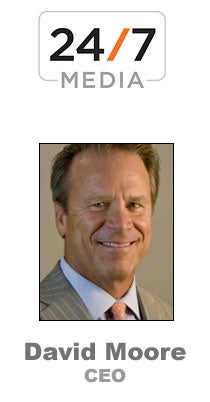
CEO Moore On 24/7 Media: We're A Tech Company, Not An Agency

David MooreAt a time when data and technology are an integral part of the advertising/marketing chain, the concept of the traditional ad holding company is changing. Once thought of as mere tools to be accessed on an ad hoc basis, data and tech are now central to the process of media buying and planning.

That was probably part of the thinking of WPP Group’s Sir Martin Sorrell five years ago when he surprised many tech M&A observers and beat out Microsoft to acquire interactive shop 24/7 Real Media for $649 million, which last week shortened its name to 24/7 Media. It followed that small, but noteworthy, bit of news with word of a strategic partnership with DG’s MediaMind, that is intended to put third-party online ad serving and TV ad delivery squarely in 24/7 Media’s hands.

Although unrelated, the two announcements reflect the changes taking place in the larger business of advertising: on the one hand, it’s about the nature of expanding the function of the interactive disciplines within the agency realm. It’s also about figuring out how to constantly improve the efficiency and accuracy of digital buys along audience buying by asking whether its best to build these skills in-house or out. The answer, Dave Moore, 24/7 Media’s chairman and CEO, told us, is sometimes all of the above.

AdEXchanger: After all these years, what was the idea behind the rebranding and why now?

DM: If you remember, the company started as 24/7 Media. We bought Real Media at the end of 2001 and changed the name at the time. And it was unwieldy, especially when giving someone your email address. Aside from that, we started a new unit a few years ago called the Media Innovation Group. It will be our five-year anniversary since being purchased by WPP in July.

(more...)


Google Click Prices Continue Slide in Q1; YouTube ‘Anchors’ Many Big Brand Campaigns

Google Q1 EarningsGoogle’s average click costs slipped further in the first quarter (see the release), continuing a decline that has pleased advertisers and alarmed some investors.

Aggregate paid clicks, including both on Google’s sites and its network partners, grew 39 percent over Q1 2011 and 7 percent over the previous quarter.  As it did, average cost-per-click fell 12 percent year-over-year and 6 percent sequentially.

CFO Patrick Pichette addressed the trend at length on the company’s earnings call today, saying several factors have contributed. Among them: pricing trends in emerging versus developed markets; spending shifts on network versus in-house sites; and the shift from desktop to mobile search, where ads generally cost less due to lower demand.

Pichette noted some investors have assumed the price trend indicates weaker demand for Google ads in general.  “One important signal we have for advertiser demand is bidding behavior,” he said. “Our advertisers’ bidding process continues to be very strong and growing…  We believe the shifts in CPC and paid clicks do not reflect the health of the business.”

Pichette held up the SiteLinks product as an example of an ad format that draws less spending but that Google believes will pay off in the long run. “You have less CPC for additional Sitelinks but if you have a better ad people click a ton on them,” he said.

Later in the call, CEO Larry Page picked up on the shift to mobile and its impact on ad prices. “People always spend the most on whatever is the major source of revenue,” he said, adding “the ability [of mobile] to do local transactions, to really easily communicate with people” are reasons the company has invested in products like Google Wallet and Offers, its daily deals platform. “Since you spend most of your money locally, over time CPCs may get better.”

(more...)


Will SSPs and Ad Networks Sell Publisher Inventory Through DoubleClick Ad Exchange?

Publisher NetworksIt wasn't too long ago (Feb. 2010 on the Official Google blog) that Google VP of Product Neal Mohan was encouraging publishers to go directly to the DoubleClick Ad Exchange (AdX) with their inventory rather than through ad networks and yield optimizers: "Maximizing revenue across various ad networks is sometimes called 'yield management.' For major online publishers, the Ad Exchange offers an easy-to-use yield management solution — it selects the highest paying ad from across multiple, competing ad networks, in real time. However, the Ad Exchange goes further than simple 'yield management' to provide a more complete revenue maximization solution."

But, those days appear to be officially over as last week the company announced from its DoubleClick Publisher blog that it would welcome publisher networks to its DoubleClick Ad Exchange, "We've revised our policies to allow publisher networks to use the Ad Exchange even if they own & operate few (or none) of the sites they represent. As always, every partner site has to meet the same high-standards of quality as every AdX publisher." Read more.

AdExchanger reached out to a selection of network and sell-side platform executives and asked the following:

"What's your take on the announcement? Can you see your company hooking into DoubleClick Ad Exchange with your publishers? Why or why not?"

Click below for the responses or scroll down for more:

Jeff Pullen, CEO, AudienceScience

"As a digital marketing technology company that looks to help our clients to be most effective and efficient with their spend, we have access to a lot of inventory that sometimes goes unused. Although some of our publisher partners would like us to increase the percentage of inventory we can fill for them, we would only consider utilizing advertising from AdX if we could do it in a way that allows us to meet all of our publisher obligations regarding competitive exclusion lists, ad quality, etc."

Bill Todd, President, ValueClick Media

"ValueClick Media is a buyer on exchanges, not a seller. For the network portion of our media business, the vast majority of our publisher partners don’t work with exchanges at all. This is because they get higher eCPMs and fill rates with us than they would from exchanges, due to our exclusive data and our optimization technology. So, for us, putting our network inventory on exchanges would defeat the purpose. Instead, we’ve found the better fit with exchanges to be our ability to acquire inexpensive inventory from them and enhance it so that it becomes more valuable and productive for our clients."

(more...)


DSPs, SSPs, DMPs, Ad Exchanges Help Inspire New, IAB Data-Driven Ads Site Says Exec Dolan

Patrick Dolan, IABToday, the Interactive Advertising Bureau (IAB) announced the launch of the organization's new "Data-Driven Advertising" site. See it now at iab.net/data. And, read the release.

Patrick Dolan, EVP & COO of Interactive Advertising Bureau (IAB), discussed the announcement with AdExchanger.

AdExchanger: What triggered the creation of the site? Any anecdotes you can share?

PD: DSP, SSP, DMP, Ad Exchanges - the explosion of new systems, process and products caught most of the community off guard. There was and is a lot of confusion about how data driven advertising works. When you brought up this subject in meetings you could see folks heads nodding but most were too embarrassed or shy to admit that they didn't know what going on. To address the IAB Data Council formed a working group to specifically focus on marketer and agency education. Initially we were thinking we'd create a presentation that any Data Council member could use. What we realized is that the subject matter was so interactive that we had an opportunity to develop a destination that could evolve with the landscape itself and provide a place to learn.

According to the release, the new site is "to be the definitive resource for advertising professionals on how data is used to serve ads to consumers." Don't ad pros already know about how data is used? If not, which ad pros is this for?

We know that many folks who are working within the industry are savvy about ad targeting, but you'd be surprised at how many people don't truly understand exactly what's happening under the hood. They are still confused by all of the acronyms (honestly, who wouldn't be?), and they don't quite understand the differences between pieces of the ecosystem like networks and exchanges. In the last few years alone, the number of targeting companies has exploded. You can tell by any of the landscape charts out there that it is quite hard to see how everyone fits in. For more seasoned marketers, it's even more complicated. Not only do they have to stay on top of the most current tools and tech available, they also have to continue to expand their knowledge and rethink the traditional models of buying they used in their past. If you think about it, there is still a major amount of dollars that we're trying to help people to move online - probably over $30B in 2012 alone. We hope that a resource like this can help to accelerate the learning, strip away any fear, and help marketers to take advantage of what the space has to offer. One anecdote here - A senior marketer at a well-known CPG brand came to us for a bit of education in this space earlier this year. After a briefing using the site as a guide, the marketer thanked us for helping to illuminate how this was all working. We are seeing this same experience with people in the more junior ranks who are just getting up to speed in their roles as well.

(more...)