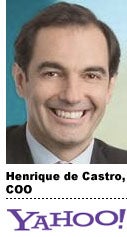
 In his first high profile appearance since jumping from Google to Yahoo, Henrique De Castro, the portal’s COO, took the stage on the second and final day of the Interactive Advertising Bureau’s Annual Leadership Meeting to showcase the company’s vision under his fellow ex-Googler, CEO Marissa Mayer.
The content vision, as demonstrated by the new Yahoo homepage, appears heavily influenced by Facebook and Twitter’s never-ending page scroll, De Castro are hoping to package it under their chosen banner of “Web 3.0.” The highlight of this “Web 3.0” philosophy is centered on what De Castro said would be the “personalization” of content, which he described as a mix of ever-more highly curated and targeted content that would create a more valuable brand experience powered mostly by adjacency and a cleaner, less cluttered look.
“Web 2.0 is the web of huge quantity, where social media comes in and helps filter that,” De Castro said by way of distinction with that somewhat passé description associated with the rise of Facebook, Twitter and social news readers like Digg. “This is where data starts to become more important. Web 3.0 will become really personalized. It’s not about 7 or 70 or 7 million articles for users to sift through and websites like Yahoo to aggregate. It’s more about how do I pick the right article just for you? Based on signals we can deliver it personalized experience for every single Yahoo user.”

While many audience members we spoke to afterward thought the Web 3.0 idea a bit gimmicky, De Castro was praised for his spirited defense of Yahoo, which has fallen as the display leader behind Google and Facebook.
Observers at the IAB conference, which was titled Big Data & Big Ideas, any hope of insight into how Yahoo would match its gargantuan content and its huge visitors with specifics about advertising were probably a bit disappointed. There was no mention of its exchange platform Right Media or its data management system, Genome. Instead, De Castro asked for patience on the advertising front.
“If you don’t get the content right, you won’t get the advertising right,” he said. “We need to personalize the content at scale. That is how we will find advertising success.”
The content would come mostly from big media content partners through homepage integration with the likes of ABC’s Good Morning America, which has worked with Yahoo in some capacity for roughly a dozen years. There would also be room for vertical integration with marketers — perhaps a microsite or special sponsorship opportunities and native advertising, as well as e-commerce opportunities, such as the one Yahoo has with Shop NBC.
“Yahoo can be a publishing platform for different types of mixes, both editorial and advertising,” he said. “Web 3.0 is going to be immersive and will require a lot of scale – and very few media outlets have our kind of scale.”
During a brief Q&A period moderated by IAB chief Randall Rothenberg, De Castro was asked what happens to media planning when Yahoo “personalizes” its content. What do agencies do to create plans?
“The planning is going to look at the audience backwards, because you will pick and choose the targets,” De Castro said.
Asked about his transition from Google to Yahoo, De Castro said the change gave him a new appreciation for the mundane, behind the scenes work done at department stores. “All retail is the same: you take products from suppliers, put it on the shelves,” he said. “The product assortment is critical and it takes time. Merchandising content and advertising on the web and merchandising on TV is different. There’s an art and science and I never appreciated much until I came to Yahoo.”
Rothenberg helped elaborate on De Castro’s points about the featuring of well known content partners alongside its own in-house editorial product, suggesting that Yahoo is like Bloomingdales, in that it “sells its own store brands and others brands.”
“I agree with the analogy,” De Castro said. “Everybody can be on our platform. That is our vision. And with Web 3.0, we have expanded it.”