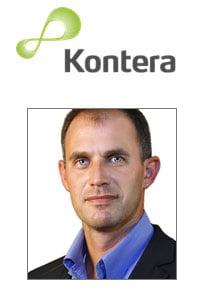
 Yoav Shaham is CEO of Kontera, a pay-per-click ad network.
AdExchanger.com: What trends are you seeing from your clients today?
YS: We are seeing “classic branding” verticals adopting and investing in our category at a faster pace. This includes CPG, Automotive, Consumer Electronics, etc. One of the stories unfolding for us this year is the power and ability of In-Text to deliver on the brand-awareness and engagement front. Accordingly deal sizes are going up and CPCs are now augmented by focus on engagement metrics and CPV (Cost per View) pricing. All the good things one would expect as brand advertiser dollars flow to online, and specifically to effective and proven online brand-building methods.
Why will Kontera continue to thrive in spite of some who say that the ad network model doesn’t have long to live?
It is true that we are an “ad network,” but there are some key characteristics that set us apart from the vast majority of ad networks in the marketplace:

- We have a significant technological advantage with Kontera Synapse, our core web-relevance engine, which analyzes, learns, and links actual page contents to related information and ads. This is not something that a website can just build on its own, and traditional display networks do not have a comparable core offering.
- Kontera In-Text has been shown to deliver 4 to 5 times the advertiser efficacy of traditional display ads (comScore, July 2010), and this is provided to publishers with no opportunity cost, in that they need give up none of their other display real estate.
- Our network is exclusive. We are the only in-text provider within the pages of our publishers. One of the challenges that display networks and exchanges face is that a web site’s participation in the network may not mean much, since each site works with multiple networks and only choose whose ad to use “on the fly.” The true scale of the networks, their member sites, and inventory are vague concepts, and smaller then they often appear. In our case there is absolute clarity, as we are the sole In-Text technology provider to each of our member sites. There is no arbitrage, inventory shifting, commoditization or brokering transactions within the In-Text domain.
I think that these make us very compelling to both publishers and aadvertisers. Moreover, I personally am not so convinced that ad networks will fall by the wayside.
You raised $15.5 million last July. What have you used the funds for to-date? Any more fundraising in the future – or any thoughts about an IPO?
The funding allowed us to significantly scale our field operations, R&D, and overall go-to-market stance. We’ve also expanded geographically into Europe. It’s been a business accelerant, to support organic growth and it enables us both to grow and to deliver greater value to our advertisers and publishers. We’ve also maintained plenty of dry powder, as we value nimbleness and the ability to hyper-focus our investments when we need to do so.
We do not comment on future financing, be they through private or public markets, but that was a good try. 🙂
How many employees do you have today? Is Kontera profitable today?
We currently have about 145 employees. As a private company, we avoid discussing profitability.
Can you see in-text advertising becoming part of an ad exchange model? Why or why not?
That depends on one’s perspective. I think that it would be very hard for an exchange to attempt to become an intermediary that represents In-Text players to publishers. The main challenges would be that there are few in-text players, and there is a very high bar in terms of the technology investment required, for the exchange to do in-text analysis on millions of pageviews in real-time.
On the other hand, I can see In-Text players participating in exchanges to receive display ad inventory and hyper-targeting those ads across our network of sites, within the most relevant topical context.
What has surprised you about digital advertising this year?
The strong brand advertiser demand that we saw surge in the 4th quarter of last year continued right into the first half of this year. This was gratifying to see.
It was also good to see the brand-awareness and engagement-focused advertisers, that I mentioned earlier, seeking new modes and high-impact formats that can deliver verifiable brand-lift results. Historically we’ve seen that focus on performance from direct response advertisers, and now we see an increase in marketer focus on the efficacy and results from a brand-lift and market-awareness perspective.
How do you differentiate from competitors such as Vibrant Media or Infolinks?
Advertiser Results.
Time and again we’ve delivered superior results to key advertiser metrics; both engagement and brand lift on awareness campaigns, and back-end behavior metrics in the case of response oriented campaigns. This is because of the technological edge in which we’ve invested.
As I mentioned earlier, the in-text players represent exclusive inventory, and we have basically “split” the publisher inventory and audience with one of the players that you mentioned (comScore May 2010). Our networks are of comparable size and we represent similar advertiser spending within the US.
Can a marketer buy audience with in-text advertising?
Yes, they can with Kontera.
We massively aggregate a highly qualified audience from across the web. These are large numbers of consumers who are currently researching and engaging in content related to the detailed topics of interest that a marketer chooses to target. We call this topical targeting, and it goes beyond the more primitive notion of specific keyword buying, since we identify and deliver the users based on their true topical interests and current intent. This approach allows our advertisers to advance consumers through the purchase funnel, and to make a significant impact to the audience at all stages.
When we reach the marketer’s audience in this targeted way we see five times the brand-awareness impact that traditional online display delivers, we see a high double-digit lift in purchase intent, and 2.5 to 5 times the impact on actual consumer behavior 3 weeks after they see our ads (comScore, July 2010).
What do you see as the next growth area for Kontera?
Several large initiatives are underway. I’ll save most of them for a future conversation, but one area that is front and center is our geographic expansion. Until this year we catered to a global publisher network through a largely U.S.-based ad-sales organization. This year we are expanding our agency and client-facing organization to Europe. We are doing this at a fairly fast rate, and the local markets are responding very nicely.
The company was begun in 2003. If you could do one thing differently in the past 7 years, what would it be?
Given the reception we’re seeing in the European market, I’d say that we probably could have done this particular expansion earlier.
Follow Kontera (@kontera) and AdExchanger.com (@adexchanger) on Twitter.