On Wednesday, Warner Bros. Discovery hosted its first quarterly earnings call with investors since agreeing to sell itself to Paramount SkyDance in late February.
Atlhough the company leadership’s team touted their upcoming content slate and newfound growth opportunities, it still felt a bit like the beginning of the end of an era. (Although, maybe that was because CEO David Zaslav started the call with a heartfelt tribute to CNN founder Ted Turner, whose death was announced earlier that day.)

As per usual, WBD’s total revenue was slightly down for the quarter, from almost $9 billion in Q1 2025 to $8.9 billion in Q1 2026.
Total advertising revenue came out to $1.8 billion for the quarter, a year-over-year decrease of around 8%. Just as in Q4 of last year, this dip was attributed to the absence of the NBA, as well as declining domestic linear audiences.
Streaming Success
At least eleven Oscar wins – four for “Sinners,” six for “One Battle After Another” and one for “Weapons” supporting actress Amy Madigan – is nothing to sneeze at.
Now, all those award-winning films live on WBD-owned HBO Max, which, ironically, decreased its streaming content revenue almost 27% YoY to $68 million last quarter.
But that was the sole outlier for WBD’s streaming business, which otherwise saw a decent amount of growth. Streaming revenue increased 7% YoY to $2.9 billion, while advertising revenue grew another 19% to $284 million, thanks to a continued increase in global ad-lite subscribers.
In his opening remarks, Zaslav said that he sees “nothing but strong growth” ahead for HBO Max, which he considers to be a “global high growth asset.”
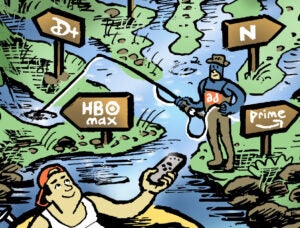
That framing is a little ironic, too, considering that Warner Brothers only just renamed the service from “Max” last year. But it’s especially interesting in the wake of earlier comments from Paramount Skydance CEO David Ellison, who told investors in March that he wants to consolidate HBO Max and Paramount+ together.
Given WBD’s own attempt to consolidate HBO Max and Discovery+, Zaslav would know a thing or two about the challenges of that particular gambit.
“Having more scale of great content and storytelling on your menu is clearly valuable,” he said. “What we learned is, aggregating it all together in one place isn’t always the best way to create the most value.”
To be fair, Zaslav was answering an investor question about WBD’s own history with integrating a large business at scale, not throwing shade at Ellison. Still, the parallels are there.
Linear? What’s linear?
Meanwhile, the financials for the global linear networks business feel less than encouraging.
Last quarter, Chief Financial Officer Gunnar Wiedenfels told investors that they might see some growth coming out of 2026 on the advertising side of linear.
So far, that is not the case. Q1 ad revenue dropped 12% YoY to $1.6 billion, while total global linear network dipped 9% to $4.3 billion.
Wiedenfels, however, said he still sees “encouraging signals” coming out of linear, particularly in international markets. That is, if you still want to separate it out as linear.
“We have long stopped viewing our linear networks as linear networks,” added Wiedenfels. “We have created creative teams that are creating fantastic content that works across platforms, and we are generating significant returns with every dollar we’re spending in that business.”
But of course WBD would be more interested in presenting its linear, studio and streaming content as a unified front these days. Unlike Netflix, which only wanted the studio and streaming businesses, Paramount is planning to buy the whole kit and kaboodle.
And as everyone now knows, an acquisition deal isn’t done until the last bit of ink dries.