

The TV industry is quickly shifting toward streaming, but there’s no standard for pricing across platforms and ad formats. That makes it difficult for buyers to accurately measure or benchmark ROI against competitors, as well as for networks to effectively optimize yield across platforms.
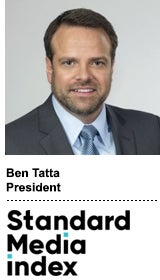
Ben Tatta, the founder and former president of TV attribution company 605 Group, joined Standard Media Index (SMI) last month to fix that problem. SMI is a pricing data co-op that collects and normalizes invoices from the major holding companies to help brands and buyers benchmark and analyze spend.
“One of the biggest issues we dealt with at 605 was getting granular pricing data,” Tatta said. “The move to census-level data is old news at this point, but relatively new to TV.”
Tatta is building solutions and applications that enable buyers and sellers to do more granular pricing analysis with SMI’s data set. He’s also focused on expanding SMI’s client base beyond agencies and brands to networks and attribution companies that need more stable and accurate pricing data.
Eventually, SMI hopes to develop standards for TV pricing. “We don’t want to repeat what happened with Facebook and Google in CTV and OTT,” Tatta said.
Tatta will run SMI’s US operations while CEO James Fennessy grows the business internationally. SMI will launch in more than 12 markets within the next year and a half to help global brands analyze pricing across markets.
Tatta spoke with AdExchanger.

AdExchanger: What can SMI clients do with its pricing data set?
BEN TATTA: We map the data so an impression is assigned to the right media owner, and the ad format definition is consistent. Then we push that back in a refined feed so agencies can compare it to the rest of the industry. It’s a standard way of comparing and analyzing effective rates across platforms and devices.
It also allows clients to understand how they are performing or how efficient a campaign is relative to that category. It’s helpful to get insight into how rates vary since a lot of premium video platforms are relatively new.
On the sell side, SMI helps networks understand spend and pricing across the platforms they sell on. Linear viewing is transitioning to OTT, yet there isn’t a lot of clarity around rates, let alone standardization. SMI is creating a cross-screen service that provides consistent pricing data, so if they’re trying to compare linear TV CPMs against OTT, they have a base for doing that.
Why does SMI rely on agency invoices for this data?
Invoices show the actual rate, not the proposed rate of an ad. If you do attribution with just rate cards, it’s going to overstate the cost and make the ROI look worse. Invoices give us that level of precision. It’s not estimated or modeled.
How granular can SMI’s clients get with this data?
We have a plan to dimensionalize pricing so we can look at the incremental effect of different targeting methods and platforms. How does the rate change if you’re targeting age and gender vs. an advanced target, like auto intenders? What’s the incremental price for luxury auto owners and how does that compare on linear vs. AVOD? What’s the value of running adjacent to a particular show, whether it’s on TV or OTT?
You can get a relatively good line of sight on that for digital, but TV isn’t sold that way. That’s where a lot of the pain is.
What trends have you noticed in the data so far?
I’m fascinated at the value of an ad targeted using first-party CRM data. It’s accurate, and it’s interesting to see the incremental price brands are willing to pay.
Networks launching DTC offerings are looking for linear parity with Nielsen. But in some cases, they can charge more [on OTT] if they over-index on a hard-to-reach linear demo. We can analyze the base rate for a spot on a particular show on Roku vs. linear TV and how other dimensions, like interactive overlays, add value if it’s sold on Roku.
Who else is collecting pricing data this way?
It varies by market, but a lot of it is manual or ad hoc. Historically [agencies] rely on small surveys and project out. That might get you in the ballpark for ratings or spend. But that won’t help you optimize spend for a given client.
On the standards front, do you compete with Nielsen?
Nielsen is a partner. Everyone has a different view of what happens to currency over time. Today on TV, CPMs are used primarily for planning and optimizing. But at the end of the day, [agencies still] buy units on age and gender and are using more detailed data to understand who to go after and where they delivered.
I think we’ll evolve to a CPM-based currency specific to the audience, not just age and gender. That train has left the building, and TV needs to catch up.
This interview has been edited and condensed.









