“The Sell Sider” is a column written for the sell side of the digital media community.
Today’s column is written by Chris Moore, head of business development at Publishers Clearing House Media.
In the last year, Google, Apple and Mozilla have clamped down on third-party cookie tracking in their Chrome, Safari and Firefox browsers, adding to an environment that is already under pressure from privacy laws enacted or on the horizon in the EU and United States.
Much of the focus has been on how changes to the top three browsers will restrict the monetization infrastructure for much of the open web, which to this day still heavily relies on cookies.
While the ramifications are quite serious for many stakeholders, these browser changes will hardly limit the practice of targeted advertising. They simply provide compelling new incentives for both publishers and marketers to move toward a targeting infrastructure built on first-party data acquired through a clear and transparent value exchange.
Both brands and publishers will find that the best path to unlocking first-party data won’t be through newfangled ad tech workarounds, but by making their products and services more essential, relevant and valuable to end consumers.

Winners and losers
Walled gardens, which obtain clear user opt-in for deterministic, user-level targeting, will benefit. For example, it’s not likely that the forthcoming changes to Chrome will limit Google’s ability to see what you’re doing online, because Google owns a deeply integrated login cookie and – crucially – that login key is needed to perform some of the internet’s most basic tasks. Same with Amazon, which needs user information to process their payments and ship their products to the correct address.
Walled gardens are not the only ones that will benefit. It would be fair to say that all publishers that are close to their consumers will flourish by virtue of the first-party data asset that such relationships confer on the publisher. For publishers and the entire sell side, there is now a powerful and growing incentive to foster direct relationships with consumers via registration, subscription or by providing alternative goods and services that require the sharing of the user’s information. The more engaging, the more immediate and the more indispensable the value they provide, the better positioned they will be for an advertising ecosystem based on first-party data.
So too with the buy side. The growing legions of direct-to-consumer brands are rich in first-party data and have pioneered the science of squeezing the most efficient performance from its application. And, as with publishers, brands providing clear value through their products and services will have a leg up in the collection, maintenance and deployment of consumer data.
Identity on the fly?
The question facing many brands and publishers, as well as agencies and demand-side platforms (DSPs) that work outside the Google ecosystem, is how to find a means to first-party-based targeting that isn’t entirely dependent on the walled gardens.
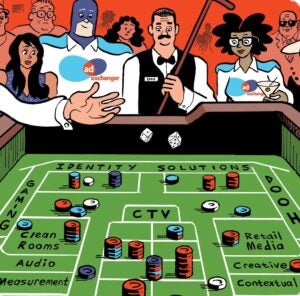
This is not a problem that can be solved by adding new layers of ad tech. The current landscape of identity solutions is fragmented and labyrinthine. If you name a supply-side platform or DSP, they’ve partnered with a different source to help fuel their ID business. While this new technological layer may seem to solve a short-term problem, it’s only creating a larger gap between the walled gardens and everyone else.
Rather, the gap will be closed by getting closer to consumers themselves. And to do that, brands and publishers will need to offer engaging experiences and quality products deserving of that close relationship.
Follow PCH/Media (@pchmedia) and AdExchanger (@adexchanger) on Twitter.