 Adaptly is one of a handful of ad-tech companies serving as a preferred partner to both Facebook and Twitter, but it doesn’t see its induction into the latter’s API program as an extension.
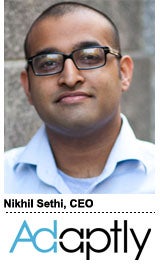
Although Twitter’s strategy has similarities to what Facebook did last year — including a retargeting exchange — Adaptly CEO Nikhil Sethi noted that Twitter members use the platforms in different ways. He said advertisers must do the same.
“We have this vernacular problem when it comes to working with sites like Facebook and Twitter, not to mention Foursquare, Pinterest and Tumblr,” Sethi said. “We call both Twitter and Facebook ‘social.’ But the activity is different, the audience reach is different. So it’s a mistake to look at these two ad platforms the same way. It’s a mistake to plan, buy and strategize the same way for both, rather than go down and look at the niche environments in each.”
Starting Wednesday morning, Adaptly became the latest of several officially sanctioned Twitter Ads API partners, which already include companies such as SocialCode, Voxsup, Kenshoo and SocialFlow. The New York-based company was an early participant in Facebook’s Strategic PMD program, offering marketers a set of analytics that promises to help them better understand the level of “engagement” their ads are generating with consumers.

The company’s partnership with Twitter is timed with Adaptly’s release of its “Go” platform, which is being billed as a cross-marketing analytics and campaign workflow system. Adaptly has been testing Go with a number of agencies — The Richards Group is one — and a few CPG advertisers. In addition to interactive ad shops, Adaptly also expects to sign public relations agencies and any other entity that is looking for “paid media optimization” for its tweets.
While it’s difficult to generalize about the degrees of variance between Twitter and Facebook, there are some clear points of divergence that Adaptly believes it can exploit, rather than simply repeating or extending the work it does on the Facebook Exchange. Mobile is a key area of difference. Portable device ads are rapidly growing part of Facebook’s revenue stream, but its exchange still doesn’t reach smartphones and tablets.
Additionally, the panoramic view that Twitter affords around trends and topics makes it a larger canvas for advertising beyond direct response. This aspect may appeal offline products and services for categories like autos and consumer packaged goods – areas that Adaptly has been working to cultivate for the past year.
“Facebook is important, but in many ways, Twitter reflects a wider reality about events and ‘trending’ topics that’s happening in a moment-by-moment,” Sethi said. “Social properties like Foursquare, Tumblr and Pinterest are about the network you create around interests. That can be many kinds of things. With Facebook, the network you create is centered on people you actually know. Those other environments are about discovery. With Facebook, you can influence your friends. With Twitter, you have the ability to [reach] a variety of audiences.”
Despite the possibilities, the insights and measurement that can provide the connective tissue between offline marketing and social media are still evolving. But the Twitter API program is likely to drive those developments and major marketer spending to support it, especially as automation and real-time bidding become more common.
“We’ve only seen a subset of the kinds of tools that are starting to become available,” Sethi said. “Until we get to the point where we’re talking about tens of millions of dollars, it will be hard to show how social media and programmatic can move the needle for major brands.”
Adaptly’s “needle” is the typical ad-tech software offering designed to speed up the ad-buying and targeting processes. It charges clients according to two business models. The first is percentage of volume, which is meant to conform to the traditional ways media is bought. Most marketers are not yet ready to adopt the “software as service” fee-based model offered by many social media vendors.
Sethi also wants Adaptly to be seen in a consultative role – the kind of position generally reserved for the agency. In addition to doing a business based on volume, it has also begun creating more tailored packages involving guarantees on reach and frequency, which is in keeping with ROI demands of marketers and agencies. The expectation is that these ways of charging will give clients a broader view of Adaptly as more than “just another ad-tech” provider.
“We want to take the basic ad-tech model, which is about presenting a set of tools, and handle the things that software should do to in clearing space for more strategic and creative thinking about a campaign,” he said. “Being able to tie in first-party data – that logged-in user of social media – and connect it to offline products and marketing. We’re going to be throwing away the cookie concept of targeting and having to develop assumptions about what people are doing on Facebook and Twitter.”
As the Nielsens and other measurement companies try to come up with the connective tissue between online and offline audience measurement, the Adaptlys want to be the ones steering the conversation brands have with consumers. That portends a clearer role for agencies, which will handle creative services and media buying and planning, Sethi said.
“We’re going to need another layer to understand individuals’ common identities across platforms and knowing how to reach those consumers within specific contexts of media,” he added. “There doesn’t seem to be a near-term solution for understanding that problem, though a lot of us are close. Helping the industry get to that point, guiding that evolution, is where we see ourselves providing value.”