

 Designer fashion retailer Monton is trying on messenger bots for size.
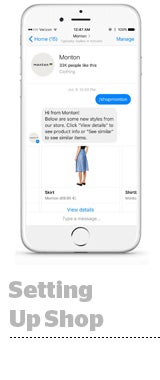
On Thursday, the brand, which targets the trendy millennial aged 25 to 30, exited beta on a product discovery tool that allows Facebook Messenger users to chat with the brand and scroll through recommendations based on previously selected items. The images link directly to product pages on Monton’s website.
Monton has a mobile optimized site, but no app and no plans to launch one.
That’s partially because it’s brutal out there for retail apps. According to Localytics, user engagement and retention for ecommerce and retail apps went down sharply between the last quarter of 2015 and the first quarter of this year. And of the ecommerce apps downloaded in Q4 2015, 63% of them were no longer being used one month after install.
Competing for installs with Amazon or Alibaba is pretty much a nonstarter for a small or mid-sized retail brand.
“We think of this as part of an omnichannel approach,” said Külli Koort, head of ecommerce at Monton, which operates an ecommerce site and just shy of 100 brick-and-mortar locations across eastern Europe.
The idea is to create an online store within Facebook Messenger, piggybacking off Facebook’s existing app with mass adoption, while at the same time reducing the number of clicks it takes to get people ensconced in Monton’s ecommerce experience.

“If you’re an ecommerce fashion site, people probably don’t buy from you every day – it’s more like every month or even every few months,” said Indrek Vainu, co-founder of Cartskill, the AI company that helped Monton develop its FB bot.
While a standalone app probably won’t get much traction, Facebook Messenger is the third most used app by unique visitors, beating out Google Search, which came in at number four in comScore’s 2015 list of the top 25 apps. In April, Facebook Messenger hit 900 million global monthly active users.
“It’s where users are hanging out anyway, chatting with their friends, and they’re already comfortable there, which makes it a good place to reach potential customers,” said Vainu, who did acknowledge that there could be a little weirdness at first when brands start nosing in on a platform known for personal connections.
 “But Messenger is actually very pull-oriented,” he said. “You can’t push things to customers there, and that’s a good thing. It’s user-initiated.”
And a precedent does exist for combining the two. Messaging apps in Asia, like WeChat and LINE, already support ecommerce. The question is whether that translates to audiences outside of APAC.
Monton is still in the experimental phase with its bot. For the moment, the brand will only be featuring a small selection of its catalog in the form of monthly designer picks. Down the line, it plans to expand what users can access through the bot, including accessories and more keyword-based product groups like “blouses” or “black dresses.”
Monton is hoping to generate sales eventually, but more realistically, the Facebook Messenger bot will start out as a tool to generate awareness and engagement.
It’s also a way to appeal to a younger demo, Koort said.
“We want to be where our younger customers already are,” she said. “Messenger bots are the future, and you’ve got to start riding the wave before it’s too late to catch it.”
The brand will also be collecting data on what items people click on, how often they click and which items seem to make them click deeper into the experience.
“Facebook Messenger could become what Google search is for fashion products,” said Vainu.
The difference is that Cartskill’s offering is focused squarely on visual product discovery. When a user chooses to see similar items, an algorithm analyzes the product image without relying on metadata or other text, and that removes some of the bias that can often creep in around recommendations, whether that’s in the keywords that were chosen by the brand to describe its item or the search terms used by the consumer.
Just because someone clicks on an orange purse doesn’t mean that person wants to see 20 more nearly identical orange purses. They just want to see purses with the same look and feel, and perhaps a few interesting wild cards thrown in for a little bit of engineered serendipity.
“The system adapts based on what you choose to look at,” Vainu said. “Because people often don’t know what they want until they actually see it.”








