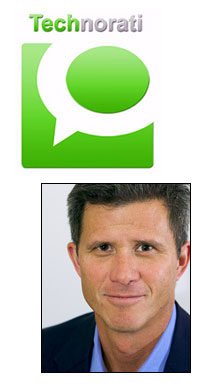
 Richard Jalichandra is President & CEO of Technorati, a social media search site and owners of Technorati Media, an ad network.
AdExchanger.com: Can you take us through some of the pivots that Technorati has gone through and where it is today?
RJ: Our evolution from a single site into a network serving billions of ads on thousands of sites each month has certainly been interesting and exciting. The company was originally founded and centered on www.Technorati.com, the first real-time blog search engine. In the company’s first few years, the site developed a strong relationship with social media content creators, and we constantly heard about their challenges in getting brand advertising on their sites – in spite of the fact that the Internet’s audience was spending more time in social media than mainstream media! So, about a year and a half ago, we launched Technorati Media, our social media ad network.
Please discuss the scale of the business today and how you support it.
Since we launched Technorati Media, the ad network has grown steadily in the number of publishers and the ads we serve on their sites. To give a sense of scale, in April, over 200 million unique visitors worldwide saw Technorati Media’s ads. How do we support it all? Rubber bands and paper clips! No seriously, a variety of proprietary and 3rd party technology, and of course, some very dedicated people.

What’s your sales strategy when it comes to display?
We enable social media at scale for brands. If you think about a brand trying to buy social media at scale, you really only have two alternatives at scale (Facebook and Myspace). So we combine hundreds of brand-safe blogs and niche social networks into a network that’s really easy and totally safe for brands to buy. Then, in addition to standard display ad units, we offer a proprietary set of conversational media ad products that we call “Cmads”, mix in a little audience targeting, and then, magic – a combination of site-specific and audience-centric conversational media.
What’s your view on the yield optimization space popularized by companies like AdMeld, PubMatic and The Rubicon Project?
I’m generally a fan of their business models, largely because the demand side has gotten way too much attention in the past year and a half, and it’s time for the supply side answer now. The “optimizers” are leading the charge to bring balance to the marketplace, with publishers and networks also doing a variety of supply-side, value creating tactics themselves. Hopefully we’ll see a healthy balance between supply and demand. That would be best for the whole industry.
Regarding demand-side platforms from your publisher perspective, do you feel you’re “outgunned” by the demand-side?
I understand the threat, but the answer is ‘not really’. Again, we offer a unique set of custom conversational ad products – our Cmads – in a brand-safe social media environs. That would be hard to do entirely through a DSP. Further, I’d even posit that some our internal ad operations emulate some DSP functions too, so while there are some threats, there are certainly opportunities as well.
Can you share broad strokes about what you’re thinking in regards to data and Technorati’s data strategy?
Like many in the space, I see us integrating our own data with third party data to create differentiated segments.
Is real-time bidding a friend or foe for publishers? Do you think it improves CPMs for non-guaranteed inventory?
I think RTB has both positives and negatives for publishers. It can absolutely help CPMs if a publisher’s inventory performs well – everyone wants it. On the flip side, the sheer glut of inventory across the web has placed downward pressure on CPMs. Given what happened on Wall Street last week, one thing that’s crossed my mind is that instantaneous, real-time transactions don’t always help markets. That’s something to ponder in our parallel universe.
What’s your biggest challenge in guiding Technorati today?
Our current challenge is just getting our story out there. Technorati Media is only a year and half old. We have a differentiated offering from many networks which results in a very high close rate with planners and buyers. So like any start-up, we just need to tell more people about what we do.
Will you let Facebook “like” Technorati, and is there any concern on your part that your data is being collected by Facebook for its own data and advertising strategies with its “like” buttons?
We’re still evaluating the impact of “Like”. There are some obvious opportunities across our network, as well as a few downsides. But we’re still evaluating them.
A year from now, what milestones would you like Technorati to have accomplished that it hasn’t already?
We have too many to list! That said, I’ll co-opt the cliché from Bull Durham and say, we just gotta take it one campaign at a time – keep innovating, keep executing and keep building a large scale media business.
Follow Richard Jalichandra (@jalichandra), Technorati (@technorati) and AdExchanger.com (@adexchanger) on Twitter.