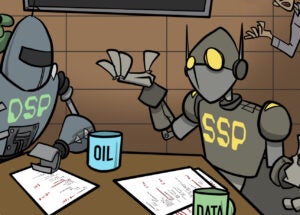
Competitive tensions and ad tech drama have flared all year.
DSPs and resellers … I mean, SSPs, have butted heads over access to bidstream data. Google screwed over every vendor that committed time and energy to the Chrome Privacy Sandbox. The Trade Desk is throwing its weight around. Prebid and The IAB Tech Lab are spilling tea all over the place.
And this drama has rippled out into the investor circle, as evident from a slew of recent ad tech company earnings reports.

Long gone are the days when all the third-party programmatic companies were eager to ride The Trade Desk’s coattails and shared a common enemy in Google.
And, in earnings reports, these gossipy narrative threads can become quite tangible.
The bottom line
The heated tempers in programmatic of late aren’t really about philosophical positions on data transparency or roles in the supply chain.
Everybody is just making less money.
Magnite, PubMatic and Nexxen disclosed that unnamed DSPs (or perhaps just one) unexpectedly and precipitously decreased spending on their respective platforms in Q3.
PubMatic CEO Rajeev Goel did point obliquely at The Trade Desk when he noted that Kokai, TTD’s new ad-buying platform, operates “differently from what we have seen.” That was similar to how PubMatic’s leadership had characterized the sudden decrease in spend from a certain DSP previously on the investor call.
In his quarterly report, Magnite CEO Michael Barrett directly noted that The Trade Desk had made a change “that prioritized OpenPath as a default path for supply.”
The SSP had to go directly to major agency buyers to reinstate a “preferred supply path,” Barrett said. TTD is a major source of demand and Magnite of programmatic supply, he added, “so there was impact.”
Nexxen, which operates a DSP and SSP, lowered its forecast for the rest of the year because the company “didn’t see this wave of growth coming into the system” that usually occurs in October, CEO Ofer Druker said in his earnings call. He noted that it wasn’t one DSP, but a programmatic-wide reduction plateau that normally jumps up before the holidays but didn’t materialize this year.
Elsewhere, System1 CEO Michael Blend said an unnamed programmatic vendor in its demand channel had saddled the company with “significant invalid or nonhuman” traffic. System1 is seeking reimbursements and may pursue legal action, he said.
The positioning
While public ad tech companies are mostly interested in their own bottom lines, the uptick in antagonism is also about vendors jockeying for position and to convince investors and marketers of their particular framing of how programmatic should work.
“I don’t think Amazon has a DSP as we define it,” The Trade Desk CEO Jeff Green told investors.
The smaller indie DSP Viant, meanwhile, “sees less competition when you look at truly objective buy-side-only platforms,” CEO Tim Vanderhook told investors. That’s his way of crafting a category of competitors that doesn’t include The Trade Desk. He characterized TTD as “no longer independent or objective” because it preferences the company’s OpenPath supply integrations.
Druker said Nexxen “saw it coming” with other DSPs like TTD crossing the ad exchange to the supply side.
“Big DSPs in the future will have to build their own end-to-end solutions in order to increase their margins,” he said.
These are totally contradictory baseline views of the world. And they’re all coming from the same small category of independent DSPs.
Among the SSPs, investors were in a tizzy about whether everyone’s new designation (by The Trade Desk) as “resellers” is a cause for concern.
PubMatic is not a reseller, Goel said. And the company is a strong partner of The Trade Desk’s, he added.
Goel is not embittered by the decrease in spend from TTD, nor about the reseller “noise that’s out there,” as he put it.
“I think what you can see here is that the ecosystem is multifaceted, certainly complex,” he said.
Barrett likewise told investors that while supply-side resellers are a very real problem, it definitely does not apply to Magnite. He said the SSP is “supportive of cleaning up the system” by removing duplicate bids and low-quality impressions.
“Again, let’s be clear, we don’t believe Magnite is a reseller,” he said. “I think the term applies to others.”