Businesses have to comply with laws and regulations; that’s nonnegotiable, unless they feel like cruising for a bruising.
But brands also increasingly want to prove that they care about ethical behavior, both their own and that of their vendors and agencies.
Brands have been asking for ways to identify and mitigate ethical risks beyond a “golden benchmark on a distant green hill,” said Andrew Susman, COO and co-founder of the Institute for Advertising Ethics (IAE), a nonprofit that establishes ethical practices and certifications for the ad industry.
In other words, advertisers want a repeatable workflow for ethics.
On Wednesday, the IAE announced an integration with SafeGuard Privacy, a SaaS-based legal tech platform co-founded by ad tech entrepreneur Richy Glassberg that helps companies manage their own privacy compliance efforts and assess those of their third-party vendors.

The integration will allow the IAE’s membership to automatically check whether they and their partners are adhering to a standard set of ethical standards covering privacy, data ethics and misinformation.
Ethics vs. the law
SafeGuard Privacy’s clients include law firms, publishers and brands, but it’s also been striking partnerships with industry trade groups and nonprofits, like the IAE.
In January, SafeGuard Privacy partnered with BBB National Programs, a nonprofit umbrella organization for ad industry self-regulation, to make it easier for businesses to demonstrate and self-certify compliance with the California Privacy Rights Act.
And early last month, SafeGuard struck a deal with the Network Advertising Initiative to automate its compliance program so member organizations can show whether they’re in compliance with state and global privacy laws and the NAI’s own code of conduct.
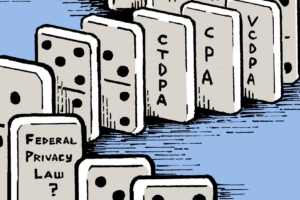
Developing automated assessment modules to comply with privacy laws is largely an objective exercise. The law is the law. But standardizing compliance with ethical principles is a different animal.
“We don’t have the right to say what’s ethical and what isn’t,” Glassberg said. “But what we can do is work with a group like the IAE and create technology so that our customers can run ethics assessments using our platform.”
Work ethics
Ethics in advertising (or the lack thereof) can take multiple forms, and questions of fairness and morality are only getting more complicated.
There’s responsibility ethics, which raises tricky questions, such as whether a brand is responsible (or not) if technology, like an AI software, for example, misleads consumers about a product’s benefits.
Then there’s marketplace ethics, which pertain to tech intermediaries that might take advantage of what Susman called an advertiser’s “imperfect knowledge” of how buying platforms work to charge higher prices.
And there are also data ethics, which involve an understanding of discriminatory algorithms or AI, the collection and use of sensitive data, manipulative design practices or dark patterns and the unfair targeting or exclusion of marginalized groups.
Although these are all complex issues, most companies wouldn’t hesitate to say they engage in ethical business practices. But demonstrating that has been difficult, Susman said, because, unlike other professions, including law, medicine, architecture, engineering and even real estate, advertising hasn’t had a set of ethical principles and standardized guidelines to follow.
The IAE, whose advisory council includes professors, academics, privacy experts and brands, had devised a set of ethical principles and practices for advertising ethics.
The next step, Susman said, is accounting for “the complexity of the advertising ecosystem, particularly in the digital space, [which] makes it difficult to trace data flow and ensure that all parties adhere to ethical principles.”
Auto-ethics
And the complexity of the online advertising ecosystem is only compounded by new regulatory obligations and growing ethical concerns.
In fact, the two are converging in the minds of regulators. Anyone who listened to even a few minutes of the FTC’s virtual public forum on “commercial surveillance” and data security in September would know that to be the case.
And so it’s becoming critical for companies to clearly document regulatory compliance efforts, as legally required by most state laws, as well as compliance with industry standards.
Both will become the cost of doing business, which is where automation comes in, Glassberg said.
“It’s about modernizing how companies have handled compliance with outside counsel in the past,” he said, “and we’re using SaaS technology to do it better.”