

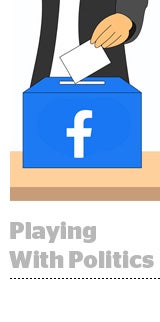
Facebook is shoring up its political advertising policies in advance of the 2020 US presidential election, which, god help us all, looms large on the horizon.
In a press call on Monday, Mark Zuckerberg laid out the steps Facebook has taken and will take to try and make sure that 2020 isn’t 2016 all over again.
A top priority is to tamp down on voter suppression. Facebook now bans any ad that suggests voting is meaningless or useless or ads that advise people not to vote. Ads that claim it’s possible to vote by text message or that promote the wrong date for Election Day are also blocked.
But Zuckerberg wouldn’t budge from his stance that political advertising has a place on Facebook, despite the relentless headache of trying to police it.
Reiterating points he made during a speech he gave at Georgetown University in Washington, DC, last week, Zuckerberg declared that getting rid of political advertising runs counter to the notion of free speech in a democracy.
Facebook certainly isn’t wading into the political maelstrom for the money, Zuckerberg said.

“From a business perspective, this controversy is not worth the very small business this makes up – this is not about the money,” he said. “Banning political advertising would favor incumbents and whoever the media decides to cover most, and I don’t think that is what we want to do.”
But what about when politicians spread lies in paid ads, either maliciously or to score political points, as Elizabeth Warren recently did when she bought an ad on Facebook that purposely contained a falsehood in order to shine a harsh light on Facebook’s policy not to curtail political speech in ads?
Zuck stuck to the talking points. “In a democracy, people should be able to see for themselves what politicians are saying, and I think people should make up their own mind as to which candidates are credible,” he said.
The sort of transparency Facebook is providing into political, election-related and issue ads through its Ad Library is “the right way to deal with these issues,” Zuckerberg said, “not to stop people from seeing the content in the first place.”
But political speech and political advertising are sensitive subjects, and there are going to be a lot of edge cases to deal with along the way.
Say a politician was to buy an ad that tried to confuse people about the voting process. In that case, Facebook’s policy against allowing voter suppression content in paid ads would outweigh its rules on allowing free rein for political speech.
Facebook gives deference to the newsworthiness of content, but because election ads often boost news stories, it’s particularly tricky for Facebook to avoid being dragged into the political advertising debate.
When policies appear to conflict, Facebook has to make judgement calls, said Zuckerberg, who pointed out that Facebook’s stance on political advertising is generally in line with the guidelines adhered to by other internet companies, like Google, and “a lot of broadcast folks,” including CBS, NBC, ABC and Fox.
Facebook has been “at the center of a lot of these debates,” Zuckerberg said, but “this is a broad-based thing and really not a policy area where we are an outlier.”
In addition to banning paid ads that promote voter suppression, Facebook is making a bunch of changes to the Ad Library, including adding labels so that it’s clear if an ad ran on Facebook, Instagram, Messenger or Audience Network, and API filters so that researchers and journalists can more easily download batches of ad creative programmatically.
Facebook is also going to roll out a US presidential spend tracker so people can see how much candidates have spent on ads.
Beyond that, the cat-and-mouse fight against misinformation continues. Facebook removed four separate networks of accounts, pages and groups on Monday (three that originated in Iran and one in Russia) that engaged in what Facebook calls “coordinated inauthentic behavior.” In the past year, Facebook has removed 50 such networks worldwide.
So all good for 2020? Sorta.
“We will continue to face the threats and probably more now than in 2016,” Zuckerberg said. “This isn’t an area where we can take our eye off the ball … or where you ever fully solve the problem.”







