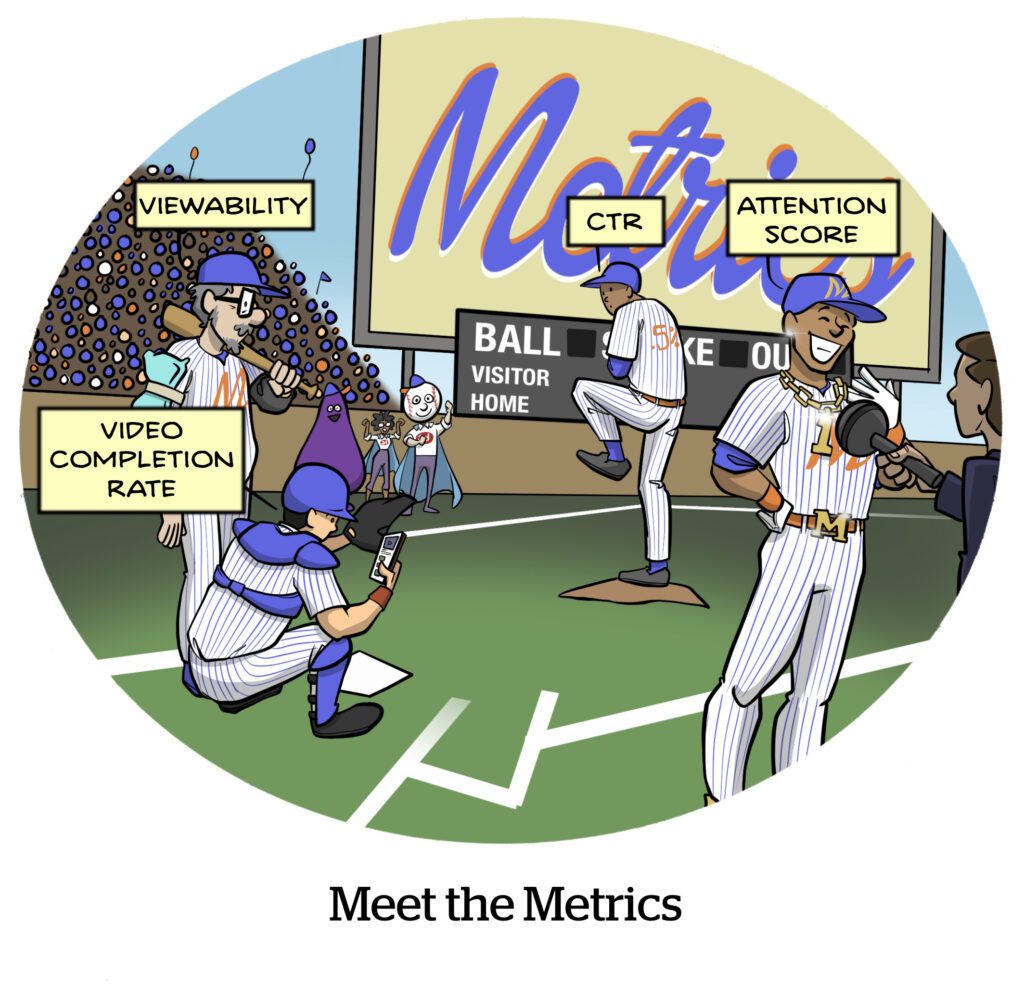
For big ad platforms that command their own media environments, standard web measurement benchmarks can seem like an awkwardly low bar.
A viewable ad, by the IAB’s accepted definition, is one in which 50% of the creative pixels are in view on the page for one continuous second.
Enticing, no?
Jokes aside, this dynamic is partly the inspiration for Custom AU for Uber Advertising, a platform metric for attention measurement that the company announced on Thursday. Two other vendors play a critical role behind the product – there’s the attention measurement startup Adelaide (the “AU” is their branded metric) and Kantar, which produces brand lift surveys to inform campaign impact.

The new attention metric helps Uber stand out among typical measurements, Edwin Wong, Uber Advertising’s head of global measurement science, told AdExchanger. “It becomes a great way to look at ad quality past just viewability, because advertisers aren’t just looking at whether or not the consumers give their attention to the ad, but whether or not it’s actually moving brand scores.”
How Custom AU for Uber Advertising started
Uber’s first taste of attention metrics actually came with Lumen Research, another attention measurement company, Wong said.
It was clear after the first attention-measurement-based campaigns that Uber outperformed what mobile web and video advertisers saw elsewhere.
“We’re constantly trying to look at the formats and at the context that we drive for the consumer, to say: ‘What are different ways that we can actually look at measurement to make it communicate the value to an advertiser?’” he said.
It is hardly surprising that Uber would outshine others for in-journey video ads, ads on screens or devices in the car or ads placed on post-checkout pages. These ads command actual human attention, whereas people screen out most general web banner inventory.
As Wong noted, attention metrics makers include factors like eye-tracking and page clutter into their models.
“We knew that, from a viewability perspective, we needed to move into more interesting, dimensionalized sort of metrics,” Wong said.
Adelaide was an attention metrics company that was able to scale the product up to being a more general release, he added.
The vendor play
For Kantar and Adelaide, the Uber integration is notable as a first platform-based custom metric for a major scaled RMN or data and media player.
“We’ve done a couple of one-offs with publishers” for custom attention measurement, Adelaide Co-Founder and CEO Marc Guldimann told AdExchanger by email. “But nothing of this scale before.”
From Adelaide’s perspective, Uber is the first partner for what it calls Custom AU. Rather than use the company’s baseline attention metric, Custom AUs are a way for publishers or media owners to incorporate their own first-party data and outcome events into a specific model. In this case, Adelaide’s general attention metric is informed by Uber’s rider and ad placement data, as well as brand lift studies performed by Kantar. Uber can use this data to connect ad impressions to surveys conducted among Uber riders during and after the campaign.
The business model in Uber’s case is somewhat unorthodox, perhaps.
Wong said the product isn’t available to Uber advertisers à la carte, exactly. The idea is that, for “premium partners,” the metric will simply be made available “to prove out the effectiveness of their inventory when they run on Uber Advertising.” And Uber will expand the metric to more advertisers moving forward, he added.
It costs Uber to run the brand lift surveys and offer the attention metric, Wong said. But it’s part of the ad platform’s effort to be “valuable to the advertiser, so that they could actually see that we’re bringing something new to them.”
And it doesn’t hurt to have an audience that’s literally locked in a car for a good long while.
“This concept of attention and captured engagement is something that all marketers are looking for,” Wong said.