

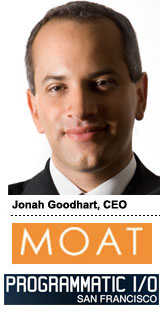
 Moat CEO Jonah Goodhart finds himself in the middle of the industry’s rocky transition from transacting on ad impressions served to running campaigns with tags to track bots and viewability.
He says the first step in this transition is to ditch the served impressions in favor of a standard that’s based on how many impressions are seen by humans. Step two: Make attention the new currency.
As publishers and advertisers move to this new currency, they are struggling to figure out contract negotiation, campaign tracking and billing. The discrepancies between ad verification vendors are also vast.
To tackle these thorny issues, Moat raised $50 million to double its employees and change the way advertisers measure campaigns, the company said Monday. Goodhart, who will discuss fraud and viewability on April 14 at Programmatic I/O in San Francisco, talked to AdExchanger about what’s ahead.

AdExchanger: First, let’s talk about that $50 million Moat just raised.
JONAH GOODHART: We think there is an opportunity to ultimately move the industry to a different state than the one we are in, which is an in-between state. Clearly people are not entirely happy with ad-served counts. Human and viewable will have to be the new baseline for all transactions in digital advertising, whether that’s in an ad server, inside Moat or inside another system.
What does raising $50 million say about where there is room for Moat to grow?
We have a $150 billion digital advertising industry, and the vast majority is transacted using served impressions. If we look at where we are today versus the potential, we are at the very beginning. We are hiring and growing internationally. Not everything we do is viewable impressions. We have huge potential under the umbrella of analytics: things like content analytics, connected TV analytics. Forbes’ editorial team uses us to understand what articles people read, how fast they scroll. From our perspective, there is a limitless opportunity to make sense of a lot of the challenges in digital.
What about moving beyond human, viewable impressions to something based on attention or engagement?
Marketers will ultimately want to pay for the attention of the consumer that they are trying to reach. My hypothesis is that attention is the resource, the commonality of what a marketer wants and what a publisher sells. Ad-served impressions are far from that. Transacting on attention rewards content creators for content that grabs people’s attention. It rewards marketers for buying the right people and attention instead of the theoretical ad server call. Even if we don’t get all the way toward transacting on attention or engagement this year, we are making the right steps.
What does that look like today when a brand like Unilever, your client, uses Moat?
Today, a lot of marketers are focused on human and viewable. A number of marketers have looked at how we go beyond viewable. Marketers are excited about being able to directly buy consumer attention in the end. There is a platform we power the measurement for example: Parsec [formerly Sled Mobile]. They are a cost-per-time platform. Their entire business model is set up to allow advertisers to transact on time, and it’s 100% viewable.
Publishers today are talking about scale as a commodity that can be gamed, and engagement as a true goal. That transition seems enabled by tools like Chartbeat, which allow editorial teams to measure engaged time vs. page views. What’s your take on this?
We are complete believers in what Chartbeat is doing on the content side, and the analogy is exactly right. Page views are a fictitious way to understand quality. What is a page view? You can break a page into three pieces and add “next” on the bottom, and you get three page views. Page views do not equate to human attention. What Chartbeat has done is say, “Let’s try to understand effectiveness, but through a different lens.”
Can Moat show that two publications, each with 20 million uniques, have completely different value to advertisers?
It’s early, but there is the potential to ask a lot of new questions as we go from the served impression to the human and viewable impression to attention. Page views are very different from an engaged reader. That’s the risk we take as an industry. If we distill down to served impressions or page views, we end up optimizing to the wrong things. At the end of the day, we think this is about quality and attention. Attention is the scarce resource we have, and it’s what every advertiser, writer and editor is after.
There’s a lot of friction right now transacting on viewable impressions. What’s the way out?
We are trying to change how transactions occur in a $150 billion industry. It’s not going to be easy. There is a lot of operational friction, but we are trying to put all the right pieces in the right places. We have a partnership with Mediaocean where their billing unit could be Moat viewable impressions, and that’s in the operational back end. On the publisher side, we have a partnership with Operative, which does forecasting and inventory optimization.
What will happen with discrepancies between vendors, which is a big pain point right now? Will they decrease over time?
I think the numbers get closer together. But there are not 20 to 30 in the market at scale today [as MRC accreditation would suggest], but two or three. It’s pretty much us and Integral Ad Science.
Will Moat’s technology ultimately look more like an ad server or more like a ratings system?
I don’t see how you can have any metric that doesn’t have the denominator of human beings. Ad serving and audience demos don’t make sense if it’s not human and viewable. I don’t see this as one or the other, I see them being combined. We have a partnership with Nielsen, and clients today can see Nielsen [Online Campaign Ratings] audience data and viewable data combined. We think these types of partnerships make a lot of sense.







