

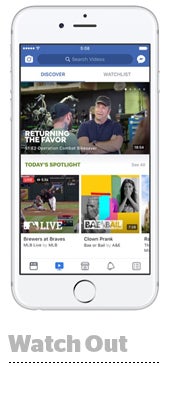
YouTube, watch your back? Facebook said Wednesday that Watch, its video-on-demand service for episodic content, is now available globally.
Creators in certain countries – Ireland, the UK, Australia and New Zealand, to start – will also be able to monetize their content with ad breaks, including pre-roll, mid-roll and static image ads. An additional 21 countries will get monetization turned on in September, which should add a decent amount of inventory.
Monetization has been a top priority for Facebook since Watch launched in the US last August because it’s a top priority for content creators. Facebook has a lot to prove. Its track record of building trust with publishers isn’t the best.
“Publishers have been loud and clear that they want more opportunities to monetize their videos, and that’s not really surprising,” Fidji Simo, Facebook’s VP of product for video, told AdExchanger. “Ad breaks are a big part of what we did last year.”
Creators get 55% of the revenue generated, which is the same split YouTube offers.

In order to be eligible to insert ad breaks, Watch publishers need to create videos that are at least three minutes long, have 10,000 followers and generate more than 30,000 one-minute views within a two-month period.
According to Facebook, more than 70% of mid-roll ads on Watch are viewed to completion.
But advertising isn’t the only monetization opportunity, said Matthew Henick, head of content strategy at Facebook, who pointed to Brand Collabs Manager, a tool that Facebook uses to match digital creators with brand partners. Facebook is also working on a crowdfunding option.
Engagement on Watch has grown steadily over the past year. Around 50 million people tune into Watch content for at least one minute every month, and total time spent watching videos has increased by a factor of 14 since the beginning of the year.
It’s premature to say that Facebook has a YouTube killer on its hands, however. YouTube has roughly 1.8 billion users who spend an average of one hour per day watching content on mobile.
But Facebook is gunning for a different type of engagement to stand out in “a very crowded marketplace of video streaming services,” Simo said.
“Beyond the numbers, what’s really important for us is that Watch is not just a passive consumption experience,” she said. “The difference is that Watch is a place for people and their friends to connect and for fans to connect with the creators themselves.”
Features like Watch Party, for example, allow groups to view any video simultaneously with members alongside a dedicated comment section, while creators can use polls to interact with their viewers.
And engagement with video is higher in Watch, which is home to longer form shows like “Red Table Talk” with Jada Pinkett Smith and live content like Major League Baseball games – at least when compared to video consumption on core Facebook.
“When people come to Watch and their intention is to watch videos, they spend five times more time than when they’re in the news feed watching video,” Simo said. “That tells us that the experience we’ve built, one that is fully dedicated to video, keeps people more engaged.”








