

The Trade Desk is unable to serve ads to the Safari browser for Apple device owners that have downloaded iOS 27, which is the latest Apple operating system update.
IOS 27 was released on September 14.
Apple has been investigating the issue since last week, although there’s no resolution yet – at least not from The Trade Desk’s perspective.
Neither The Trade Desk nor Apple responded to requests for comment in time for publication.

The latest iOS expands upon Apple’s preexisting policy of unconditionally blocking data broker domains that do addressable ID matching and facilitate tracking across sites.
Other tracking services that were added to Apple’s block list this month include The Trade Desk-backed Unified ID 2.0 program (which uses the domain UIDAPI.com), ID5, Audigent, LiveRamp and Permutive.
But that’s not TTD’s main issue. Its problem now is that Apple added another of its domains, adsrvr.org, to the blocklist, which some programmatic insiders might recognize as TTD’s domain for third-party cookies.
And now alarm bells are going off at The Trade Desk.
“Adsrvr.org is The Trade Desk’s core ad request and delivery domain, not identity,” writes Ian Meyers, The Trade Desk’s senior director of engineering, in an urgent request to Apple’s WebKit team on WebKit Bugzilla, the platform it uses to track software issues.
In other words, Apple has done more than just block the mechanisms that The Trade Desk uses to match post-cookie identities. The other vendors WebKit blocked are straightforward identity data sellers and ID graphs. But with The Trade Desk, WebKit has effectively completely shut down the DSP’s access to Safari inventory for devices with the latest iOS.
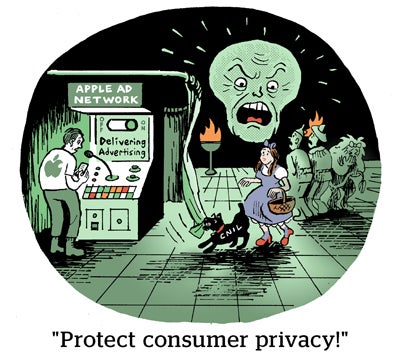
Apple’s move underscores its unique ability to act as a sort of Sword of Damocles hanging over the ad tech industry.
Here’s the best-case scenario: The iOS 27 update inadvertently blocked The Trade Desk’s root ad serving domain. If so, the past couple weeks (and counting) will soon be just a painful memory once this is resolved – and that’s, of course, the outcome TTD is hoping for.
“Thanks, John! If you have an ETA on your findings/feedback, that would be appreciated.” That was the follow-up Meyers sent on WebKit Bugzilla last Friday to John Wilander, manager of WebKit privacy and ad tech. Wilander had responded a few days earlier in the thread that he’d seen the flag and would investigate on Apple’s end.
As of Monday, however, Wilander’s only update was, “I will let you [as in, TTD’s Meyers] know if and when any changes are available for you to test.”
In other words, it’s still possible Apple will eventually resolve this issue.
But there’s a more troubling hypothetical for The Trade Desk, which is that WebKit reaffirms its decision to unconditionally block the TTD domain.
The WebKit group has been evaluating this GitHub ticket for more than a week now and apparently hasn’t come to a conclusion about how to treat TTD’s adsrvr.org.
And there’s another wrinkle.
The Trade Desk’s WebKit bug report includes an ad call for a yahoo.com non-private browsing session that saw TTD’s bids blocked by Safari. Google’s bids, though, went through cleanly. (Although the DoubleClick brand is no more, Google still uses the “ad.doubleclick.net” domain, because while product names change all the time a cookie domain name lasts forever.)
In the past, Apple has made targeted changes to its ad tracking policies that suddenly laid low advertising systems operated by Meta and Criteo, among others. The Trade Desk is now having its own painful experience in Safari’s penalty box.
So, what’s next?
It’s TBD whether this whole incident will be easily shrugged off as a rough couple of weeks and a lesson learned about the slow pace of Apple’s updates and approvals process – or whether it’s a sign of very rough days ahead for the programmatic open web.











