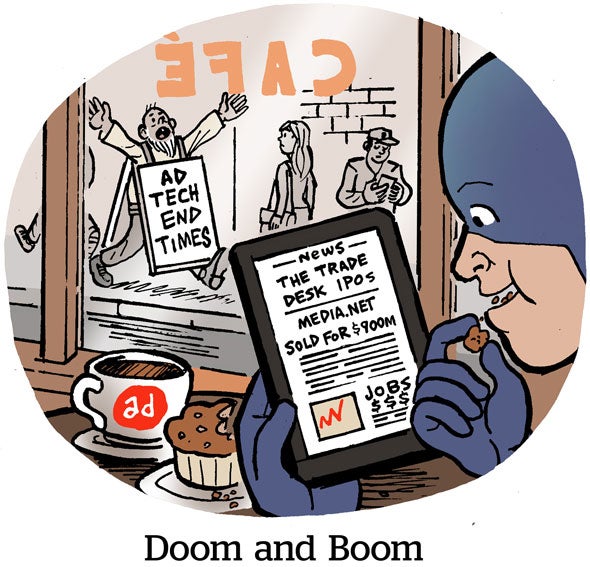
The Trade Desk has delivered another smash earnings report, with $585 million in Q2 revenue, up 26% year-over-year.
The company, which reported on Thursday, generated $85 million in net profit, more than double the $33 million it generated in Q2 2023.
Meanwhile, Unified ID 2.0, the open-source identity initiative created and backed by The Trade Desk, has “reached a critical mass of adoption,” CEO Jeff Green told investors.

UID2 is “addressing much bigger issues and is expected to have more ubiquity than cookies ever did or do,” he said. “[It’s] an identity framework that works across all digital advertising channels, not just a couple of walled gardens that own browsers.”
Speaking of walled gardens that own browsers, Green spent a moment reveling in Google’s legal woes. Google lost a major search antitrust lawsuit earlier this week and faces another suit focusing on its ad tech business.
“In my opinion, the Department of Justice’s case against Google on the ad tech side is even more compelling than it was on the search side,” Green said.
Paying for premium
Yet, increasingly, TTD is moving beyond its historical focus on the open internet and reframing itself as a “premium internet” company.
For TTD, the new premium internet isn’t the free-for-all of content people create and consume together (i.e., “the web”); it is content coming from mostly large media companies opening their properties to programmatic tech.
Green cited major UID2 distribution deals from the past month alone with Fox, Roku and DirecTV. Pandora integrated with the UID2 program in June, and Green also highlighted Spotify.
“When I say [UID2] is becoming ubiquitous, I especially mean in CTV and in audio, in places where people are logged on,” Green said.
Google’s left turn on third-party cookie deprecation may give some publishers pause when rethinking their identity strategy. The notion that Google may not ever deprecate cookies, which will live on like Twinkies or cockroaches in a postapocalypse hellscape, is now more credible than ever.
But publishers should quickly adopt authentication strategies or they’ll be left behind – by TTD advertiser budgets, at least. Even if Google doesn’t make another move, Green said, the time to act is now because so-called premium channels are the future.
“Things like UID2 are so effective for CTV and audio and other channels that have log-ins,” he said. “It will make it so that we prioritize that media over those that are just dependent on cookies or something else.”