
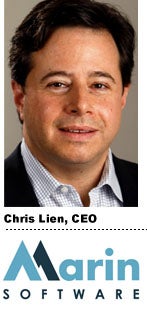
 Ad management services provider Marin Software became the latest private tech company to go public, and it’s first day of trading on Friday was indisputably positive for executives behind the decision. Now, of course, comes the hard part: getting to profitability and managing expectations along the way.
In a conversation with AdExchanger a few hours after ringing the opening bell at the New York Stock Exchange, Marin founder and CEO Chris Lien said he had told investors and analysts in the lead up to its first trading day that the company would not be profitable until 2015, when he expects the company to break even.
Between now and then, Marin will not use the $105 million booked from the sale of 7.5 million shares sold to buy its way to growth. Nor will the seven-year-old San Francisco company switch gears to open its system widely to biddable display. The plan is to continue to double down on search as well as social and invest aggressively in sales & marketing and research & development. Don’t expect any big acquisitions either. “Our growth will come organically by adding more advertisers to the 531 customers we currently work with,” Lien said. “To the extent that we see opportunistic acquisitions, they will likely be smaller, technology-focused ones. We’ll consider those.”

The company feels confident that it can maintain shareholders’ patience until it turns losses into profits. Marin says it had $59.6 million in sales last year for 65% gain over 2011’s revenues.
On top of that, Marin achieved a good deal of notice from advertisers and agencies from its profile as a leading search engine marketing provider and its work with Facebook. Plus, the company has raised $100 million in funding since it opened its doors in 2006 and as Lien told us, already had $30 million on the balance sheet — surely enough to provide a foundation for future growth by ordinary ad tech standards.
Still, Lien feels the company benefit in other ways from going public.
“The main reason for going public is to gain more attention and visibility to our company and our category,” Lien said. “We were pretty well funded as a private company. By raising awareness of what Marin does in the public markets, we can attract more prospects and further accelerate our growth.”
Marin currently employs over 425 people across 25 offices in nine countries. It added 140 employees last year and expects to add roughly the same amount this year. Marin will staff up throughout the company, with no location or department getting the bulk of new staffing.
Lien expects growth to continue to come from search marketing, followed by social and display. The vast bulk of its current revenue, 90%, comes from search. Five percent comes from social and the remaining 5 percent from biddable display. Within search, mobile contributes 20%.
“At a high level, we want to be thought of as a revenue acquisition management platform,” Lien said. “We do see social and display becoming larger slices of our revenue mix, but we’ll always be primarily focused on search, because it’s such a large category.”
At the moment, though, social media spending is growing faster than biddable display for Marin, thanks in part to Facebook, so there will be some additional focus there.
“When I talk about social, I’m mainly talking about ad management on YouTube,” Lien said. “But we’re also talking about Facebook, which has a variety of ad formats. For the most part, the [marketplace ads] on the right hand side of the screen are fairly analogous to paid search. Then, you have sponsored stories, ads in the Newsfeed and all the other API-enabled ads which are unique to Facebook. And that’s why we’re so bullish on them, because they’re so large and have so many unique advertising features.”
As an ad manager, Marin is also at the center of media buyers and advertisers attempts to better understand what to automate when it comes to ad sales and placement, and how the human element of the process fits in and is evolving.
“Marin is a technology platform enabled by people, and we don’t envision a Terminator-like future where machines and borgs run everything,” Lien said. “People can be more effective and strategic by using technology, and ultimately, they’re the ones making the decisions. Our job is to take all the data and transform it into actionable business information.”







