
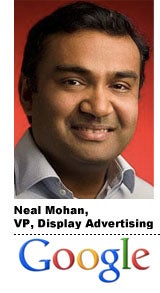
 Google’s is taking its time adding features from supply side platform AdMeld, acquired nearly two years ago, to its DoubleClick Ad Exchange. Doing so is an ongoing process, Neal Mohan, VP for display advertising products, told AdExchanger in a discussion of Google’s attempts to broaden its appeal to brand-name publishers and big-spending marketers.
This week, the company issued a blog post promising publishers more transparency and tighter controls around the bidding behaviors of advertisers, demand-side platforms, and trading desks. Google also redesigned its AdX dashboard to simplify the process of finding and blocking unwanted ads.
“I never look at it as if there’s a final end state to an integration like the one we’ve been doing with AdMeld,” Mohan said. “There’s more work to be done there, for sure. I would look at this announcement as a milestone of how it’s coming together and how evolution of the ad exchange has become more than just a way to transact real-time bidding, but also assist publishers’ premium, direct sales.”

There has been no decision about whether the AdMeld name will remain, Mohan said, when asked if that brand will go the way of Invite Media, the DSP Google acquired nearly three years ago and eventually rechristened as Bid Manager.
“There was a certain rationale for changing Invite Media’s name because it was a such a critical component of our buy side, DoubleClick stack, so it made sense to rebrand it to reflect that alignment. It made more sense from a customer standpoint. On the publisher side, the vision has always been to create a one-stop shop platform for sellers’ needs, regardless of the channel, the format or the device. We haven’t made a decision around whether or not to keep the AdMeld name specifically.”
Rather than focus on nomenclature, Mohan wanted to talk more about the features being added for publishers.
The company has high hopes for Bid Landscapes, which is intended to blunt fears from publishers that by running a DSP on the other end of its DoubleClick business, Google could have a conflict of interest. Bid Landscapes’ promises greater insights into trendlines over time of how various advertisers and DSPs value their inventory.
“Bid Landscapes could be a good lead gen driver for publishers, because it details how the programmatic channel is doing on an advertiser by advertiser basis,” Mohan said. “Publishers get a clear sense of what portions of their inventory are attractive to specific buyers. If they can find pockets of higher demand they can quickly make the shift and turn that better transparency into greater revenue.”
The appeal to publishers will be crucial for Google to maintain the online advertising advantages it has reached as it battles Facebook for dominance of display. In general, Google now holds more share than any other company in the U.S. online search, display and mobile advertising markets, respectively, according to eMarketer. To put that in further context, Google accounts for more than 41% of all digital ad revenues in the U.S. And it attracted more U.S. display dollars than any other company this past year, topping the overall $14.98 billion US display ad market with a 15.4% share. Facebook took home a slightly lower share, with 14.4%, the researcher said.
With all that in mind, Google executives have been talking up the idea of “premium programmatic” for months now, calling out the false dichotomy between automated media buys and traditional direct selling.
As SSPs have been promoting the idea of private exchanges or marketplaces for years now — though many deride the concept as a marketing tool, arguing that publishers always have the option of setting any and all kinds of controls around pricing and which advertisers get to view their inventory — Google is also highlighting functions like its “preferred deals” for reserved programmatic sales. To those who believe that Google wants to see the entire ad sales processed “automated,” building up the preferred deals offerings is designed to show that programmatic and direct sales can be complementary.
“This concept of preferred deals is that it’s a way for advertisers and publishers to consummate a pre-negotiated deal,” Mohan said. “We’re now augmenting that with private auctions. You may have some inventory you don’t want to make available in the open exchange and we’re offering them a way to generate more demand. As to how much of the sales process should be automated on the publisher side, I think those decisions will be made individually depending on the publisher’s objectives and needs.”
Since publishers are increasingly embracing social media platforms like Facebook and Twitter as a way to distribute ad-supported content, as opposed to regarding it as a threat to their traffic, Google also sees a role for Wildfire, a tool for advertisers to manage their brands across earned media channels that the search giant bought last summer.
There has been some speculation about how Google would use Wildfire since the Facebook Exchange was launched last fall, especially since Google has been locked out of using that system.
“The driver behind our acquisition of Wildfire was to live up to the vision of the DoubleClick platform as a place they could manage and get insights into all of their digital marketing efforts, whether it was through paid tools like DFP or Bid Manager, or through earned components that go through social channels like Wildfire. We’ve been busy figuring out interesting ways of how it integrates with the DoubleClick buy side suite. There’s nothing to announce on that front yet, but stay tuned.”








