Bid shading is a technique buyers use in first-price auctions to avoid paying too much, and its importance has increased as every major exchange has switched over to a first-price auction.
“Bid shading uses an aggregated view of the market to avoid overpaying,” said Matthew McIntyre, head of programmatic EMEA for Essence. “DSPs or exchanges look at where auctions normally close, and try to estimate whether they can reduce that bid without reducing the probability of winning.”
Besides pricing data, bid shading algorithms look at factors like site, ad size, exchange and competitive dynamics to determine where to set the bid. If win rates decrease, they’ll raise the price they pay.
“[Deciding] the proper amount to bid on the auction … depends on knowledge of the exchange, sites, and many other variables that may also change over time,” said Ari Paparo, CEO of Beeswax. “Getting it right can save a lot of money, while getting it wrong can mean you lose opportunities to bid on valuable inventory.”

Who does bid shading?
A handful of DSPs and exchanges offer bid shading, including all the leading players. Google’s DV360 rolled out optimized fixed CPM bidding last year, a free bid shading tool. The Trade Desk charges a fee for Koa, its bid shading algorithm, where it pockets a percentage of how much buyers save on each impression. MediaMath also developed bid shading capabilities.
On the exchange (supply-side platform) side, Rubicon Project unveiled Estimated Market Rate (EMR) at the end of 2017 to help its DSPs transition to first-price auctions, and PubMatic released Intelligent Bidding in February 2018. Google Ad Manager will also temporarily do “bid translation” for small DSPs who need help reducing a high second-price bid to a slightly lower first-price bid.
Buyers must rely on a DSP or exchange to do bid shading for clients because agencies and marketers don’t have access to the full bidstream data, McIntyre said.
Essence prefers using a DSP’s bid shading tool over an exchange’s. “If an SSP is employing a technology, they have 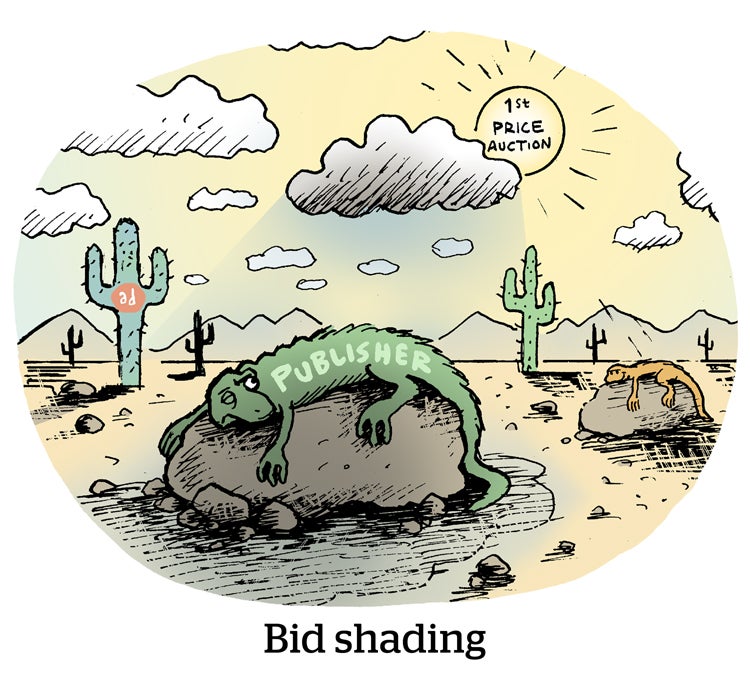 the objective that you win through their exchange, whereas a DSP will make a broader evaluation of the opportunity,” McIntyre said.
MediaMath wants both DSP and SSP to do bid shading collaboratively. “Two-way data sharing [will] make both shading solutions smarter and complementary,” said MediaMath product lead Sara Skrmetti. “If we work separately and don’t inform one another’s approaches, we might end up negatively affecting advertisers’ performance, so this two-way communication is critical.”
For example, if an exchange does aggressive bid shading when an advertiser wants a high win rate – like to reach its most valuable users or to spend before a campaign ends – that higher loss rate will negatively impact the advertiser, Skrmetti said.
What buyers save
Buyers save about 20% with bid shading, according to figures released separately by The Trade Desk, Rubicon Project and PubMatic.
Wide adoption of bid shading tools is already driving down pricing. Three-quarters of The Trade Desk’s clients use Koa, and more than half of the DSPs Rubicon Project works with EMR.
Publishers have been feeling that 20% average price reduction.
Before bid shading, many buyers didn’t know how to adjust their bids for a first-price auction and temporarily overpaid, which benefited publishers. Now, publishers are seeing CPMs fall back down, and stand to see further declines if bid shading algorithms continue to improve.
When to bid shade
Bid shading makes the most sense for branding or prospecting campaigns. “Our advertisers have seen effectiveness with bid shading in first-price auctions when used for prospecting – to appropriately value new users and/or new sources of inventory,” said Varick CEO Paul Dolan.
Essence employs bid shading most for branding campaigns. The technique allows it to create dynamic CPMs, which mimic the fluctuations in clearing price that occur in a second-price auction.
But marketers, beware: If an agency is bidding the same amount for an impression everywhere, and the DSP isn’t varying that bid, that marketer is overpaying, Essence’s McIntyre warned.
For a direct response pus h, Essence plans to rely more on goal-based campaigns, where machine learning optimizes toward a CPA or CPC goal. Those campaigns already create wide CPM variance, without having to think about bid shading.
Is it transparent?
Bid shading uses black box algorithms to lower bids. And there’s still no clear way for buyers to judge how effectively a partner is bid shading, Essence’s McIntyre said.
He’d like to see DSPs develop an “opportunity curve,” so buyers can more easily see the trade-off between win rate and pricing that happens when buyers bid shade.
Varick wants to make sure bid shading doesn’t become another complicated black box.
“How do we maintain transparency into price and value when bid shading is applied?” Dolan said. “We are working with our DSP partners to answer this and roll out best practices for all our clients.”