

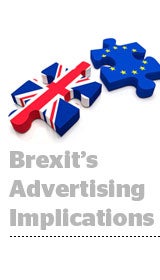
 Britain is leaving the European Union. Though the process will take up to two years, the news sent agency stocks tumbling.
What everyone wants to know, but can only make educated guesses about, is how this will affect the digital advertising industry.
AdExchanger asked a few digital executives to take a gander at how this historic referendum will affect the industry. They made four predictions for how the UK leaving the EU will make waves in the advertising world.
Prediction 1: Changes In Data Protection Ahead
EU has tough data protection laws, namely the General Data Protection Regulation.
While the law “aims to strengthen and unify data protection for individuals in the EU, it has severe implications for the internet’s commercial sustainability,” said Anthony Rhind, chief strategy officer at Adform, which is based in Denmark, an EU member country.

It’s possible that in the wake of the decision, the UK, which will no longer be beholden to the law, will loosen data restrictions to be more competitive, Rhind said.
With new regulations “considering the business needs of those companies investing in innovation and employing people in-market,” he said, “we think the UK could align with equivalent US legislative process and set an example for the EU commissioners, demonstrating the value of distinct decisioning process that considers the common interests of citizens and multinational corporations.”
Practically, UK leaving the EU and no longer being subject to its data protection laws means that companies might need to undertake several actions, such as moving their servers from the UK to an EU country to serve the EU market.
“We have servers in the UK, which meet EU data protection requirements,” said John Nardone, CEO of UK-based Flashtalking. “It remains to be seen if we will have to move those servers into an EU country moving forward,” he said.
There will be plenty of time to do it and it’s not a challenge – more of “a pain in the neck.”
Prediction 2: Expect Short-Term Headaches And Thumb Twiddling
“There will be a period of financial instability and uncertainty, just as there was during the campaign and as we witnessed post-Brexit day one,” said Jon Hook, GM of advertising at Phunware, which has offices in the UK and US. He noted one bright spot: The British pound rallied before the end of the day.
“People may delay infrastructure and investment decisions because of uncertainty,” Rhind said. Companies working in multiple currencies face headaches. That “is an obvious area of concern for business planning [since] exchange volatility is a negative complexity and cost area.”
While uncertainty may increase confusion and harm planning, it’s worth noting that the transition could take two years.
“In the short term, I don’t think this has much impact,” Nardone said. “It will be a couple of years before it is all implemented,”
Prediction 3: Media Companies May Thrive
Proponents of the exit said it would make the UK more attractive to businesses, Rhind said.
“Time will tell if this proves true, but it is realistic to expect the UK government to seek to highlight areas of differentiation quickly,” he said. “Media in its broadest sense is likely such an area.”
That means TV, film and publishing, along with advertising, will be targets to make the UK look good, since “UK-domiciled companies and UK citizens make a significant contribution” in those industries.
Prediction 4: Brexit Could Lead To Increased Transparency
As companies scan ad budgets to figure out the Brexit impact, Hook predicted this will lead to more understanding and transparency in the industry.
“For the digital media industry, I see this as a positive event,” Hook said. “Why? Transparency is a hot topic already and I expect any cut or heightened examination of how and where ad budgets are being spent will only push transparency further up the agenda.
“Digital media and ad tech business focused on building transparent tool sets for brands will continue to thrive, and those operating a ‘black-box’ business model will continue to struggle.”







