

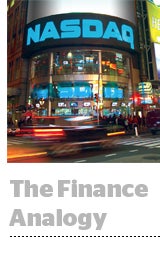
 Now and then the question comes up. How vulnerable is the digital ad ecosystem to the technical problems that occasionally knock out trading in the major financial markets? One such glitch hit Nasdaq on Thursday, freezing out investors for three hours. Time to revisit!
Once the preferred way of explaining RTB to one’s relatives, the “financial analogy” for programmatic media has gotten a little long in the tooth. Still, seven years after the advent of the term “ad exchange,” its underlying premise remains valid. Both kinds of marketplaces support high-volume, many-to-many trading — performed in real time or near-real time. And both are vulnerable to hiccups.
But there are key differences that protect today’s ad buyers from being locked out of marketplaces en masse – the way brokers were on Thursday. The main one is that there are many ad exchanges.
“There are multiple trading platforms in ad tech today, thus spend is distributed instead of localized to two main US financial markets,” said Alanna Gombert, senior director of programmatic and trading at Conde Nast.

And the field of display exchanges is more diverse each year, as social-ad platforms “come online” in the RTB space. Facebook launched its retargeting marketplace a year ago, and Twitter is putting the pieces in place now for its own RTB participation. The stock market, by contrast, is an oligarchy with just two major exchange operators in the US. Hence, it’s more vulnerable.
What about other types of “trading mistakes?” A recent programming error by Goldman Sachs set stock option prices far too low and caused orders to flood American exchanges early last week, costing the bank as much as $100 million.
The odds are slim that any such system failure or human error will lead to massive “media trading losses” in the online ad space. That’s because losses created by mistakenly undervaluing inventory would be on a much cheaper scale – and isolated to whatever publisher or go between caused the error.
But the distributed nature of digital ads is no guarantee against downtime – and advertisers and agencies are bound to notice when that downtime hits the biggest players, such as the DoubleClick Ad Exchange or FBX.
According to Duncan McCall, CEO of PlaceIQ, “While there’s not necessarily the same single-player marketplace model, there still exists the same inherent risks that computing or digital glitches that could cause large swings, shutdowns and erroneous behaviors.”
Gombert agrees, though she sees limited risk: “Because the ad-tech trading markets are campaign-based, there are ways to make up the downtime by front loading. Regardless, glitches and issues do result in revenue loss in the short term, of course.”
Concerns about uptime are likely to track with growth in RTB spending. US marketers are on track to invest $3.3 billion in RTB ads this year — 19% of all digital ad spend. That share will grow to 29%, or $8.69 billion, by 2017. Platform players had better be ready.
“As the digital advertising market matures and becomes more and more programmatic,” McCall said, “a focus on security, regulation, failover and controls will be more and more important.”








