After reporting its fourth quarter results on Wednesday, Criteo’s stock popped by more than 17% and hit a 52-week high. Criteo’s stock has gone up more than 300% over the past year.
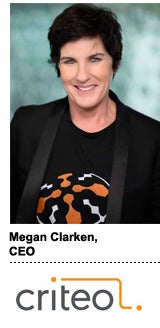
Criteo, whose revenue grew by 1% in Q4 to $661 million, is taking a clear-eyed approach to the end of third-party cookies, Criteo CEO Megan Clarken told AdExchanger.
There isn’t a company whose business touches the internet that isn’t exposed in some way to the deprecation of third-party cookies or the privacy changes Apple is making within its ecosystem, she said, and so there’s no point in trying to shy away from the magnitude of the challenge.
Criteo told investors that it’s planning for a roughly $60 million impact from privacy and identity-related changes coming this year using its 2020 run rate as the baseline.
Clarken also pointed to LiveRamp, which reported its latest quarter results on Monday. During the call, CEO Scott Howe acknowledged that although transitioning away from third-party cookies will be a net positive in the long run, it’s also going to cause “financial implications” in the near term.

For example, LiveRamp is planning to sunset the portion of its business that licenses the cookie-based components of its digital graph to technology platforms, the overall impact of which could be up to $30 million in 2022.
“Anybody who has exposure should be making sure they’re being transparent about it,” Clarken said.
Over the past 18 months, Criteo has been working to reduce its own exposure. Although retargeting is, and will continue to be, core to the business, she said, Criteo’s top priority is to build targeting products that serve its growing base of ecommerce and retail media customers.
Criteo added nearly 900 net new clients in the fourth quarter alone, the highest level of increase it’s seen since the end of 2017.
Today, the new solutions that Criteo is developing for its commerce media platform, including its first-party data assets and retail media solutions, make up around 20% of company revenue. Retargeting is responsible for the rest.
But that split will start to equalize as Criteo builds out its commerce suite. Revenue from new products is growing at a rate of roughly 50%, and Criteo expects new additions to its product portfolio to represent close to 30% of its business by this year.
“What’s important here is that those products also mitigate the risk of headwinds from third-party cookies going away, because they don’t actually rely on third-party cookies,” Clarken said. “They’re resilient.”
And that’s where first-party data comes in. Criteo’s first-party data set, which it gets through direct integrations with its retailer clients, contains billions of shopper transactions, Clarken said.
Even Amazon has a hard time finding their logged-in users when they leave its walled garden for the internet at large. That dynamic, combined with first-party retailer data, is Criteo’s opportunity, she said.
“Ecommerce in 2023 will be about $6.8 trillion in spend and, yes, 62% of that spend will go to the big walled gardens, but 38% of that will go to monetization of the open web,” Clarken said. “And that just says we’re looking at the right [total addressable market].”