 It’s a safe bet that the next generation of TV advertising and analytics will be an incredibly lucrative category.
But that’s about the only safe bet anyone can make.
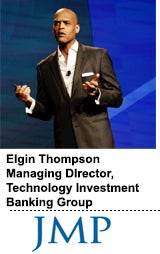
“There are a lot of question marks around this space,” said Elgin Thompson, managing director of technology investment banking at JMP Securities.
There are fundamental questions about whether ad-supported video players will be profitable and, vice versa, whether ad-free subscriptions will be sustainable without an advertising revenue stream to bolster them.
AdExchanger spoke with Thompson about the kinds of companies he’s evaluating as potential winners in the category.

AdExchanger: Are there any categories you’re focused on right now?
ELGIN THOMPSON: Look at Viacom acquiring Pluto. That was a big signal to the market with that valuation. There are good properties like Tubi TV and Filo still out there, and the interest should be there from a number of traditional media players trying to enter at scale this new OTT landscape.
Public markets remain relatively accommodative right now too, if you look at a company like Roku.
What I think is really interesting and a space I’m evaluating now are companies that aim to do measurement and performance for those OTT and streaming environments.
Who do you think could fit there?
In linear there’s Nielsen. And on digital there was a group of startups like Integral Ad Science, MOAT and DoubleVerify.
Are there next-gen products in that space to make sense of the addressable TV ecosystem? Distributors, advertisers and content creators will want sight lines into that ecosystem. But I don’t think it’s clear right now who that could be.
There’s a vacuum because you have this old guard that seemingly had the oligopoly environment, through some unforced errors from all of them. They weren’t able to lean forward and take advantage of the opportunity to do that themselves, because each took a winner-take-all posture when together they could have left everyone else behind.
What are the concerns about investing when things are so uncertain?
There are fundamental questions up in the air right now: Will it work? Will consumers use a selection of apps and options for OTT viewing or stick with what they have? Will some of these companies have the impact that we all think they could have?
The whole idea of cord-cutting seems like it’s been going on for a long time, but it is still fairly new. I actually don’t know how these threads will unwind.
But all those large competitors are placing their bets. Their core business has eroded and changed. And with Netflix, Amazon, HBO, Hulu, and now you have Comcast, Disney, AT&T, etc. getting into streaming, another critical question people are asking is, “What’s the breakpoint for subscription costs?”
Where are the strategic exits for this next generation of TV content and ad tech?
At some point you’ll see the big ISP companies get more involved. But we’ve seen Verizon pull out of practically everything but their core wireless business and has shown no inclination to re-enter. AT&T is still digesting AppNexus.
There are the usual suspects of Adobe, Oracle and Salesforce. And companies like Altice we hear are gearing up more to look at assets in this space. That also doesn’t include private equity, which looks at TV more actively than digital media and ad tech.
I remain bullish on the environment. Many of the behemoths have made moves, and they won’t stop halfway.
We hear a lot about a slowdown in VC funding and new ad tech companies. Do you see that impact in the startup pipeline?
I think that’s accurate that the startup pipeline has slowed. The herd mentality among early investors has definitely shifted away from ad tech and ad-based businesses generally.
Still, there are super angels and value-focused funds making contrarian bets. The issue in this space is they haven’t been exiting more than companies are being created. So what’s happening is fewer are being created because there’s less fuel behind them.
Those companies are also mostly pivoting to TV.
Some programmatic companies have become verticalized, like PulsePoint, which specializes in the healthcare industry. That could be a good hedge. But I think practically any company in ad buying should pivot toward TV, because for the moment you could avoid going head to head with Google and Amazon.