

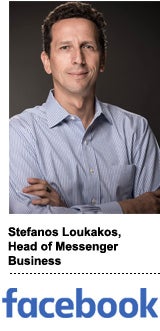
Facebook’s been doing the Cannes thing for several years, but this year was the second that execs from Messenger donned their deck shoes and salmon-colored shirts for their festival debut.
It’s an opportune time to double up on its presence. The messaging service, which has 1.3 billion users, is entered into the Cannes Lions competition by way of a Messenger bot developed by Lego that helps parents choose which set to buy based on their budget and their kid’s personality.
But Messenger is also in town to meet with businesses and creatives and help them figure out new applications for customer service and marketing.
Messenger is trying to position itself to address a common demand from clients, and one that hasn’t been as much of a selling point for Facebook: the quest for lifetime value.
“It’s the lifetime of the customer that really matters here,” Stefanos Loukakos, the head of Messenger business, told AdExchanger.
It’s free for businesses to establish their presence on Messenger, though Facebook has had ad units designed to drive traffic to Messenger since 2017.

Besides bots, Messenger business tools include an AI assistant, retargeting ads and chat plugins that can be positioned on a business’s website. On Monday, Messenger unveiled video ad units. It also has augmented reality in closed beta, which Sephora is using to let consumers try on different types of makeup.
But Loukakos is also wary of Messenger becoming an advertising free-for-all.
“[What] we don’t want to replicate on Messenger is the bot experience people have on email with spam,” he said. “Right now, we only allow businesses to proactively send messages to people they’ve already engaged with. A business cannot send you a message unless you’ve opened a thread with them.”
He added that Messenger doesn’t use the content of people’s messages for targeting.
That said, businesses that use Messenger to communicate with consumers can tap into that content for their own purposes.
“All of the communications that happen between a person and a business belong to a business, [and] the business can use [them] to retarget and re-engage users,” Loukakos said. “So, you go into Lego and buy, [and] Lego can later send you a sponsored message to sell you a product that came up. We have a lot of businesses that message for price alerts or back-in-stock promotions.”
Messenger isn’t Facebook’s only messaging app, since it also owns WhatsApp, where disagreements about the extent to allow data collection and advertising led to a divorce between Facebook brass and WhatsApp’s founders.
It looks like advertising will inevitably come to WhatsApp, though that’s not happening immediately. But when it does, it will use what it learned from Messenger.
“Messenger is ahead of WhatsApp because we have an open API,” Loukakos said. “In the future, we’ll try to align as much as possible.”
Meanwhile, Loukakos’s purview is strictly Messenger. And he knows that advertisers are wary about how ephemeral tech products can be, which is a big reason why many don’t invest. So, he’s pounding home his belief that “Messenger is here to stay.”
“On Facebook, we have around 70 million pages and 18 million businesses are already messaging their customers,” he said. “Last year, at F8, we announced 2 billion messages exchanged. This year, it has jumped to 8 billion. We had 200,000 automated experiences last year and 300,000 this year, and we have more than 200,000 developers building on the platform. The ecosystem is exploding.”
His challenge now is to convince marketers, who are already run ragged managing their websites, mobile sites, apps, Facebook, Twitter, Snapchat, TV and video presences, to devote manpower to yet another new channel.








