

When advertisers see their ad verification partners blocking lots of impressions, they often think, “Okay, good – that’s proof the technology is working.”
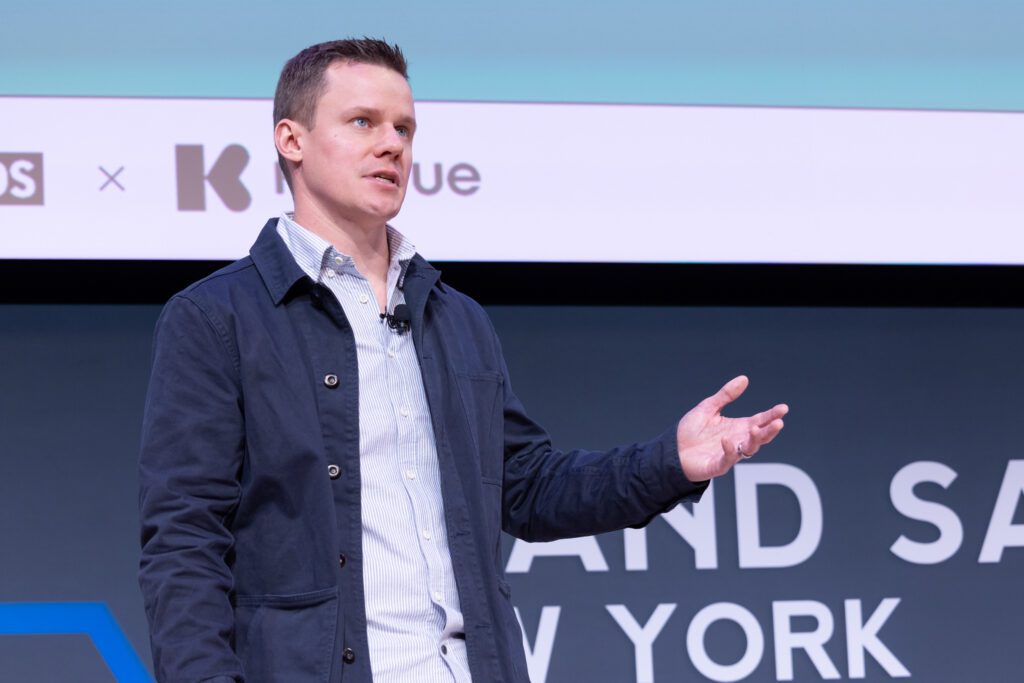
But negative blocking isn’t the healthiest – or the most efficient – way to approach brand safety, said Mark Proulx, global director of media quality and responsibility at Kenvue, the consumer health care company that was spun out of Johnson & Johnson last year.
It’s time to stop thinking about brand safety verification only as “insurance” – a way to avoid undesirable content – and start thinking about it as an opportunity to build positive brand associations, said Proulx, speaking at the Brand Safety Summit in New York City earlier this week.

Because if keyword and URL blocking is “all you’re doing with verification,” he said, “you might be limiting yourself and possibly preventing yourself from appearing against certain types of content that you’d otherwise want.”
Keeping a pulse on verification performance
Not that there isn’t a role for judicious blocking to play, so long as the rules are tailored to a brand’s specific needs.
Kenvue, for example, has a few brand-unsafe red flags, which Proulx referred to as “nonnegotiables.”
As a consumer health care company that manufacturers over-the-counter medicines, including Tylenol and Zyrtec, Kenvue is very serious about staying away from negative portrayals of health care professionals in content, which “we feel is uniquely inappropriate for our brands,” Proulx said.
But that type of content might not pose a suitability issue for a company that doesn’t operate in the health care industry.
Which is why brand safety needs to be constantly monitored and optimized, said Christal Dolan, VP of enterprise excellence at IPG-owned UM Worldwide, Kenvue’s agency partner. She sits on the OneVue team, which is an arm within UM specifically dedicated to the Kenvue business.
“There are active requirements for stewardship and management,” Dolan said. “We treat verification in the same way as we would treat any other buying parameter, by keeping a pulse on how it’s performing and what it means for you and your brands.”
There’s a cost for every blocked impression
Between Q2 2023 and Q2 of this year, the OneVue team has helped Kenvue reduce its verification-related costs by more than $3 million through a less restrictive but no less rigorous approach.
Rather than blocking any word and URL that could potentially have a negative association, Kenvue whittled its blocklist down to only include its own nonnegotiables.
For all other content, Kenvue is using AI-driven semantic solutions that analyze the nuances of language on the page. Words like “bomb” or “shoot,” for instance, aren’t necessarily brand unsafe. It really depends on the context.
And the same goes for URLs. Consider this hypothetical one: “www.website/std/daily-update.” At first glance, Proulx said, “std” looks like it could be a reference to sexually transmitted diseases, which is a real example of a term on Kenvue’s blocklist.
But what if “std” in that case is just an abbreviation for the word “standard,” which would mean the site not only isn’t problematic but might even be desirable? Blocking it could mean missing out on a good placement – and paying for the pleasure of doing so.
Ad verification isn’t free, and there’s a cost for every blocked impression. “That’s money you’re essentially wasting as part of your media spend,” Proulx said.
Say a brand is blocking 1 million impressions per month from that site at a $5 CPM. That’s roughly $60,000 a month down the drain for a single website.
“Multiply that over how many hundreds or thousands of websites you run against,” Proulx said. “And if you have a large keyword list, think about all of the other keywords you might be blocking.”
And then the report arrives from the verification provider showing that lots and lots of impressions were blocked. An advertiser that isn’t taking an active, hands-on approach to brand safety might look it and think “this is ad verification doing its job,” Proulx said.
“But you have to dig a little deeper to see whether you’re truly blocking as intended or is this a misfire?” he said. “Do I need to make adjustments and optimizations to my approach?”

Brands, get out of your own way
But brands also need to adjust their mindset when it comes to brand safety and suitability in general.
Using machine learning to go beyond the bluntness of keyword and URL blocking is an opportunity for brands to be proactively open rather than reflexively closed off to potentially valuable inventory out of fear or sheer habit.
“You can mitigate the risk of you getting in your own way as a brand,” Proulx said.
And advertisers also need to be a little more realistic and realize there is no such thing as a 100% brand-safe guarantee, regardless of what some ad verification companies claim in their marketing.
Proulx pointed to an Adalytics report from over the summer, which highlighted brand unsafe placements among publishers with a high proportion of user-generated content. Advertisers were quoted as being very disappointed, because they thought they were 100% protected.
But no technology is foolproof, Proulx said.
“This idea that verification is just a set-it-and-forget-it solution – you’re kind of just misunderstanding what those companies do,” he said. “And you’re also not getting the full value of it.”







