The word “choice” has multiple definitions.
As a noun, it means an act of selecting between two or more options. As an adjective, it means something first-rate or of good quality.
Unfortunately, in the online advertising context, the choices presented to consumers are neither feasible to make nor of good quality.
Complexity within the online ad ecosystem vitiates the entire concept of notice and choice. And even if someone is intrepid enough to try and exercise their choice about how advertisers can use their personal data, it might not even matter.
I know this to be true from firsthand experience.

47 times!!
Last Monday, I visited cnn.com to check the news.
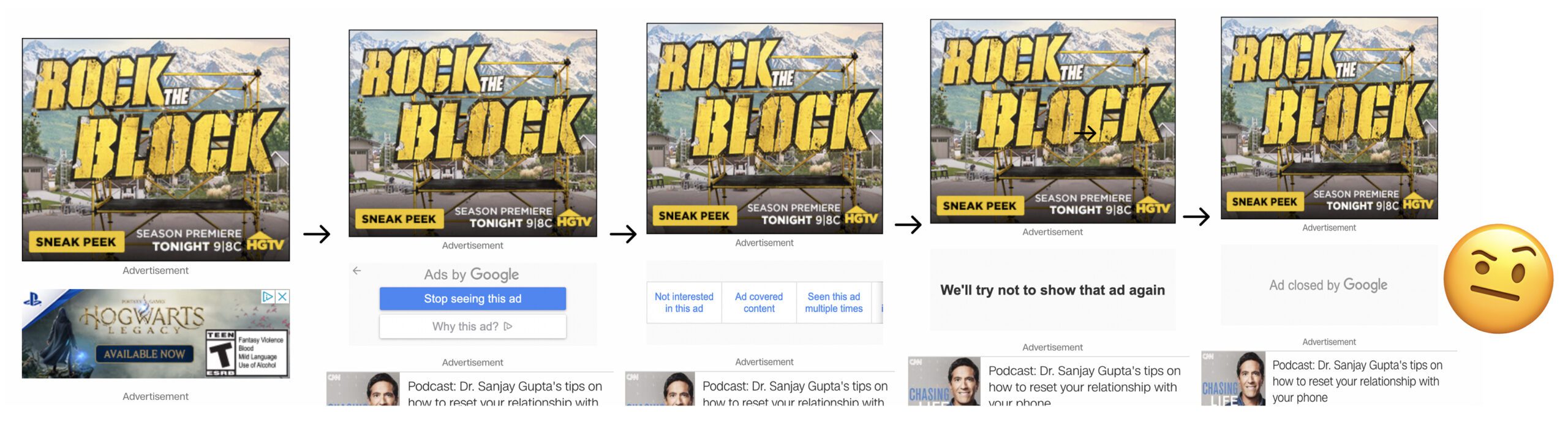
I scrolled a bit and noticed a display ad for Hogwarts Legacy, a new and rather popular role-playing game set in the “Harry Potter” universe. 🧙
I’m not a gamer and (forgive me) I never read the “Harry Potter” books, so I clicked on the little blue AdChoices icon located in the top right corner of the ad. AdChoices is a self-regulatory program launched by the Digital Advertising Alliance in 2010, ostensibly to give people more control over the collection and use of their data for online behavioral advertising purposes.
After clicking the AdChoices icon, I was presented with two options: “Stop seeing this ad” and “Why this ad?” I clicked to “stop seeing this ad” and was given four more options: “Not interested in this ad,” “ad covered content,” “seen this ad multiple times” and “ad was inappropriate.”
I selected “not interested in this ad,” after which a message appeared from Google, which was the entity responsible for serving the ad. The message said: “We’ll try not to show that ad again.” After a few moments, that message disappeared and was replaced with another message: “Ad closed by Google.”
Cool. Look at me, exercising my choices. 🤗
But then I refreshed the page to see what would happen and … there was the Hogwarts Legacy ad again, in the exact same ad slot.
Okay, maybe it takes a little time for my choice to be communicated to the appropriate parties. So I waited a bit and then went through the same process again: I clicked the AdChoices icon, “stop seeing this ad” and “not interested in this ad.” I was informed a second time that Google would “try not to show that ad again” and that the ad was “closed by Google.”
I refreshed the page a second time, made the same selections through AdChoices and I don’t think it’ll surprise anyone to hear that the Hogwarts Legacy ad was still there.
I went on to refresh the page (and make the same exact AdChoices selections) TWENTY-SEVEN times before giving up. The Hogwarts Legacy ad was there on every refresh.
But hey, I thought, maybe I’m being unreasonable. Perhaps it’ll take a few days for all the systems operating in the background to share my choices and get on the same page.
So I let my little experiment sit for two days, returned to cnn.com on Wednesday morning and went through the same process, the only difference being that I selected “seen this ad multiple times.”
I did that 20 times before losing my will to live. I mean, I have better things to do than tell the AdChoices program a collective 47 times that I’m not interested in Hogwarts Legacy. I could be watching cat videos (this one’s an oldie but a goodie) or staring at a wall or, you know, beating my head against said wall in mute frustration. 😑
Fruitless and … toothless?
I don’t care how complex the online advertising ecosystem is or whether there was some weird web caching thing going on. If AdChoices can be foiled by web caching, that’s a problem.
Regardless of the reason, the experience I described above is unacceptable.
Put yourself in the shoes of a person who actually went through the trouble to make a choice only to be summarily ignored.
Even if a program like AdChoices has only the best of intentions, if there’s no follow-through, it’s nothing but a front-row seat at the privacy theater. 🎭
Also, for what it’s worth, I showed my mom a different display ad on cnn.com this week (she’s 73 and internet savvy), pointed at the AdChoices icon and asked her if she knew what it is and what it’s for.
She looked at it for a moment and said, “Um … is it a send button?”
(So much for the consumer education campaign in 2012 to boost awareness of the AdChoices program, including this “choice” promotional video.)
Updated 3/14/23: According the the Digital Advertising Alliance, the “issue encountered was entirely unrelated to the AdChoices program.” In the words of DAA CEO Lou Mastria: “The AdChoices icon is used as a consumer gateway for information and control by scores of publishers and ad networks, and the choice tool inaccurately attributed to AdChoices was not part of the industry-wide controls managed through the AdChoices program.”
It’s been great getting messages from readers, so please keep on letting me know what you think. Drop me a line at allison@adexchanger.com.
📣 Before you scroll down any further, there’s still time to nominate yourself and/or colleagues for our Top Women in Media and Ad Tech Awards! The deadline for entries is coming up on March 16.
And we’ve got a new category this year, Privacy Powerhouses, honoring the women working across legal, business and tech who are confidently steering their media brand’s ship amidst the changing (and rising) tides of privacy regulation.